Standing outside a bathroom door at 7:15 in the morning, waiting for a sibling or roommate to wrap up, most people who grew up with a Jack-and-Jill know that feeling well. It is a shared bathroom setup that has been around in American homes for decades, and despite everything else that has changed in home design, it is still one of the layouts families ask for most when building or remodeling.
This guide will cover what a Jack-and-Jill bathroom actually is and how the two-door setup works in practice. You will also learn the layout options worth considering for this space and the design decisions that make the difference between a bathroom everyone dreads and one that just works. Sizing, common mistakes, a few floor plan examples, and where professional drafting fits in are detailed thoroughly across this comprehensive guide.
What Is a Jack and Jill Bathroom?
A Jack-and-Jill bathroom is just a bathroom with two doors. Each door of this bathroom opens into a different bedroom. Rather than stepping out into a hallway first, whoever’s using the bathroom walks straight in from their own room. The term comes from the old nursery rhyme. Builders picked it up sometime around the mid-20th century as shorthand for this connection.
What actually makes a bathroom “Jack and Jill” has nothing to do with what is inside it. You will find versions with one vanity, versions with two, some with a separate tub and shower, and some with a combo unit. What stays consistent is the access: there is always a second door (sometimes a third) tying the room to more than one bedroom. That is the piece that sets it apart from a standard hall bathroom, which is entered from a common hallway and used by whoever’s in the house, or an ensuite.
Homeowner activity backs this up, too. Bathrooms remain one of the most active categories in home improvement. HIRI’s Quarterly Homeowner Project Activity Tracker reported that bathrooms accounted for roughly 46% of home improvement projects completed in the first quarter of 2026, up from 40% the year before (HIRI, 2026). A layout that doesn’t get planned well the first time is a common reason people end up back in the bathroom sooner than they’d like, so it is worth getting the zoning right from the start.
There is a practical reason builders keep using this layout, too: two bedrooms can share one set of plumbing and fixtures instead of each needing its own full bath. That keeps costs down without leaving either bedroom stuck walking down the hall.
NAHB’s analysis of Census Bureau data found that 65% of new single-family homes starting in 2024 had two full bathrooms, the second year in a row that number climbed. Jack-and-Jill setups are a big reason builders can hit that number without running a third full plumbing line.
How Does a Jack and Jill Bathroom Work?
Each bedroom gets its own door into the Jack and Jill bathroom. This is really the whole concept behind a Jack-and-Jill layout. One person comes in from Bedroom A, another from Bedroom B, and each door usually locks from the inside. So, whoever’s in there has privacy, and the other door can’t just swing open on them.
That means the bathroom acts less like a private space and more like a shared one with two ways in. When properly constructed, such shared spaces function smoothly without daily friction. One user can use the sink while the separate shower or toilet compartment remains securely locked behind its own door, allowing the second household occupant to wait briefly or pursue alternative tasks in the meantime. If it is done poorly, it becomes the classic morning traffic jam everyone pictures when they hear ‘shared bathroom.’
A fair number of homes soften this with a small buffer zone, a short hallway or vestibule, between the two bedroom doors and the actual wet area. It is a minor change on paper, but it makes a noticeable difference in how the room feels; you are not walking directly into someone mid-routine the second you open your door.
Jack and Jill Bathroom Layout Ideas
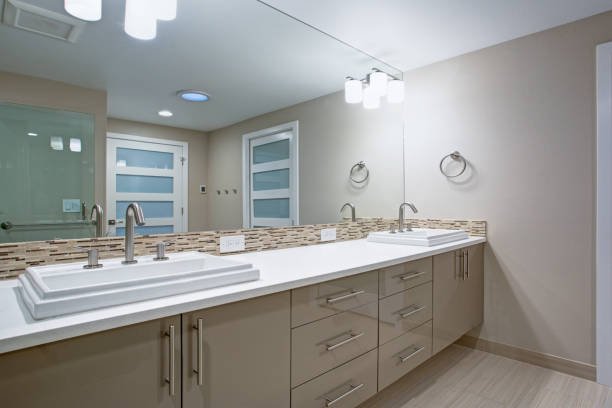
There is not one single Jack and Jill bathroom layout. The right configuration depends on the size of the bedrooms and how many people will use the space regularly. Here are the layouts we see most often in both new construction and remodels.
- Two Bedrooms and a Shared Bathroom: This is the baseline layout, with one bathroom between two bedrooms. It is the simplest version to plumb and the most common in homes built from the 1970s through the early 2000s, when this configuration was standard for kids’ wings.
- Double Vanity Layout: Each side of the bathroom has its own vanity. These vanities are often positioned near the entry door each person uses. This single change resolves most of the morning routine conflict because two people can get ready at once without crowding each other.
- Split Bathroom Layout: A split bathroom layout is divided into zones. It includes a vanity area and a separate toilet/shower area behind a door or partition. This lets one person use the sink while the other showers. It is one of the most requested upgrades in Jack-and-Jill bathroom remodels.
- Separate Toilet or Shower Area: This layout takes things a step further than the split layout. It puts the toilet and shower behind their own locking door. Two people can use the bathroom at the same time with real privacy.
- Bathroom with Hallway Access. Some layouts add a third entrance from a common hallway, allowing guests or other family members to use the bathroom without walking through a bedroom. In this layout, separate sinks keep the room functional even when it is serving more than two people.
- Three-entry Layout. The most flexible (and most complex to plumb and frame) version combines two bedroom doors with a hallway door, effectively making the bathroom a semi-public space for the household while still preserving direct bedroom access.
| Layout Type | Best For | Privacy Level |
| Two bedrooms + shared bath | Siblings, budget builds | Basic |
| Double vanity | Two daily users at once | Moderate |
| Split layout | Families wanting more privacy | Good |
| Separate toilet/shower | Teens, adult roommates | High |
| Hallway access | Guest use + bedroom use | Moderate |
| Three-entry | Larger households | Moderate to High |
Key Features of a Good Jack and Jill Bathroom
A Jack-and-Jill bathroom design succeeds or fails on a handful of details. Here are some key features a good Jack-and-Jill bathroom must have.
- Two or more entry doors, each with its own working lock
- Double or separate vanities so two people can get ready without bumping elbows
- Privacy locks on the wet zone, not just the bedroom doors
- A separate toilet/shower area, ideally behind its own door
- Adequate storage so each user has dedicated space and doesn’t have to dig through a shared drawer
- Good lighting layered so the vanity area is bright enough for grooming without washing out the rest of the room
- Proper ventilation to manage humidity from two people showering on the same schedule
- Comfortable traffic flow so doors don’t collide and towel bars are not blocking a swing path
Skip any one of these and the bathroom still “works” on paper, but it tends to become the room everyone complains about.
How to Design a Functional Jack and Jill Bathroom
Getting a Jack and Jill bathroom right comes down to a handful of early planning decisions. Below are key considerations to keep in mind when designing a functional Jack and Jill Bathroom.
- Door placement must prevent multiple panels from swinging into the same travel path. Install all entryways to open flush against interior walls rather than toward obstructions. It is good to keep at least 32 inches of clear swing space.
- Vanity positioning works best when each vanity sits closer to the bedroom door it serves. So, each person has a short path to their own sink rather than crossing the whole room.
- Toilet and shower privacy is worth prioritizing over square footage elsewhere. A single door separating the wet zone from the vanity area solves most of the complaints people have about shared bathrooms.
- Storage should be split from the start. Built-in cabinetry or medicine storage assigned to each side prevents the daily friction of shared drawers.
- Circulation needs enough clear floor space that two people can move through the room without funneling through a single narrow path. A rough rule of thumb is at least 36 inches of clear walking space between fixtures.
- Fixture spacing matters more here than in a single-user bath. Also, code minimums (typically 15 inches from a toilet centerline to any wall or fixture, and 21 inches of clearance in front of a toilet or vanity) should be treated as a floor, not a target, given how often two people use the room close together.
- Fixture selection is worth a mention too, since two people sharing a bathroom also means sharing water demand. EPA WaterSense-labeled showerheads are certified to use 2.0 gallons per minute or less, compared with the 2.5 gpm federal maximum, which can noticeably reduce hot-water wait times when two showers happen back to back on the same morning.
Get an accurate Jack and Jill bathroom floor plan today.
Jack and Jill Bathroom Size & Space Planning
The bathroom size depends on which fixtures you include and how you zone the room, not on a fixed rule. That said, a few benchmark ranges help with early planning.
| Size Range | Typical Fixtures | What It Allows |
| 60–80 sq. ft. | Single vanity, shared toilet/shower | Compact, budget-friendly, best for two kids sharing a bathroom |
| 80–120 sq. ft. | Double vanity, separate toilet area | Good balance of cost and privacy for most families |
| 120–165 sq. ft. | Double vanity, separate toilet, separate shower/tub | Full privacy zoning, works well for teens or adult roommates |
| 165+ sq. ft. | Two nearly independent zones | Functions almost like two connected half-baths |
RoomSketcher’s layout examples show working Jack-and-Jill bathrooms in the 60–80 sq. ft. range for compact homes, scaling up to considerably larger footprints when the design includes a fully separated toilet and shower zone on each side.
Cost to Build a Jack and Jill Bathroom
Cost is usually the first question homeowners ask, and it depends heavily on one thing: are you converting existing floor space, or building new square footage? A Jack and Jill bathroom carved out of an existing footprint runs a lot cheaper than one that requires a home addition, because you are not paying for foundation, framing, and roofline before a single pipe goes in.
According to Angi’s 2026 cost data, a Jack and Jill bathroom in the 100–200 sq. ft. range costs $25,000 to $60,000 when built by converting existing space, and $50,000 to $100,000 when it requires a new addition. Smaller, simpler versions cost less, while a fully zoned layout with two vanities and separate toilet and shower rooms sits at the higher end because of the extra framing, doors, and fixtures involved.
| Project Type | Typical Size | Estimated Cost (2026) |
| Convert existing space into a Jack and Jill bath | 100–200 sq. ft. | $25,000 – $60,000 |
| Build a new addition for a Jack and Jill bath | 100–200 sq. ft. | $50,000 – $100,000 |
| Compact shared layout, single vanity (converted space) | 60–80 sq. ft | $15,000 – $30,000 |
| Fully zoned layout, double vanity + separate rooms | 120–165 sq. ft. | $45,000 – $80,000 |
Pros and Cons of a Jack and Jill Bathroom
Like most shared-space design decisions, a Jack-and-Jill bathroom comes with real trade-offs. It is worth weighing them honestly instead of just picking the layout because it is traditional.
| Aspect | Pros | Cons |
| Space | Sharing one set of fixtures and one plumbing wall between two bedrooms uses less square footage than building two separate baths. It is a real factor in homes where every extra foot adds to the budget. | The primary drawback of this spatial efficiency involves limited room to separate users effectively. Compact shared layouts typically force compromises between larger vanity surfaces and fully segregated wet zones, as any major architectural expansion of floor area is limited. |
| Cost | One set of supply lines, one drain stack, and one exhaust fan serving two bedrooms is meaningfully cheaper than running duplicate systems for two full baths, a real consideration in a remodel budget conversation. | Cutting corners to keep that cost advantage (skipping a second vanity, leaving out a locking door on the wet zone) is exactly what turns a budget-friendly layout into a daily annoyance later. |
| Access | Both bedrooms get a full bathroom without a long hallway walk, and there is no need to build and plumb two separate rooms just so each bedroom has “its own” bath. | That convenience ties two people’s schedules together in a way a private ensuite never does; getting used to it vs. wanting to use it are two different things at 7 a.m. |
| Privacy | With good zoning and a locking door on the toilet/shower area, two people can use the room at the same time and barely notice each other. | Skip that separation, and one person effectively controls the whole room while they are inside it. Without a locking wet-zone door, the other person just has to wait. |
| Traffic & doors | When door swings and vanity placement are planned around clearances, two people can move through the room without getting in each other’s way. | Doors that swing into the same footprint can physically collide if clearances were not planned for. |
None of these are dealbreakers on their own. They are simply the variables a good Jack-and-Jill bathroom design has to account for, which is exactly why the layout and zoning choices matter so much more here than in a standard single-entry bath.
Jack and Jill Bathroom vs. Standard Bathroom vs. Ensuite Bathroom
People often mix Jack-and-Jill bathrooms with other standard or ensuite bathrooms, so it helps to define exactly how a Jack-and-Jill bathroom differs from the other two common types.
| Feature | Jack and Jill Bathroom | Standard (Hall) Bathroom | Ensuite Bathroom |
| Access | Two or more doors, direct from bedrooms | One door, from a common hallway | One door, from a single bedroom |
| Typical Users | Two bedrooms’ occupants | Whole household or guests | One bedroom’s occupant(s) |
| Privacy | Moderate — depends on zoning | Moderate — shared but neutral access | Highest — private to one room |
| Space Efficiency | High — shared plumbing | Moderate | Lower — dedicated plumbing per bedroom |
| Best Use Case | Siblings, kids’ bedrooms, guest suites | General household use | Primary bedroom, guest suite |
The core distinction is access and who the bathroom is designed to serve. A Jack and Jill bathroom is built around two bedrooms sharing one space; a standard bathroom is neutral, serving whoever’s in the house; and an ensuite is built around one bedroom’s privacy, full stop.
Common Design Mistakes to Avoid
Even experienced homeowners run into the same handful of problems when planning a Jack and Jill bathroom:
- Improper door positioning can cause panels to collide or obstruct vital fixtures during daily operation
- No privacy between users, usually from skipping a locking door on the toilet/shower zone.
- A single access point that is technically not a Jack-and-Jill bathroom at all. It is a frequent mistake in remodels that convert the layout incorrectly.
- Insufficient storage that forces both users to share drawers and cabinets.
- Doors blocking fixtures, where a door swings directly into a toilet, vanity stool, or shower entry.
- Poor ventilation, which becomes obvious quickly when two people shower on similar schedules.
- Crowded circulation, where the path between the two bedroom doors and the fixtures is too narrow for two people to pass.
Most of these can be fixed at the planning stage for a fraction of what it costs to correct them after construction.
Jack and Jill Bathroom Floor Plan Examples
Seeing a few real configurations makes the layout decisions above easier to picture.
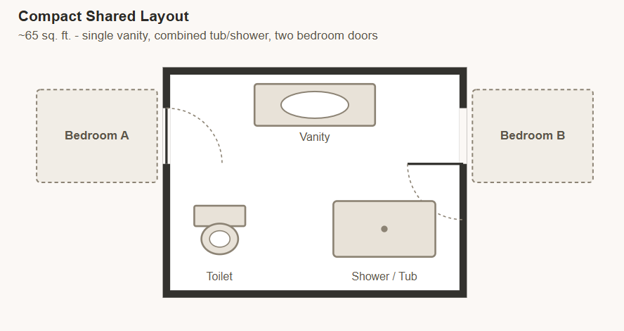
Compact shared layout (roughly 65 sq. ft.): A single vanity centered between two bedroom doors, with a combined tub/shower and toilet along the opposite wall. This works well for younger kids, for whom full privacy separation is not yet a priority, and it keeps plumbing runs short and inexpensive.
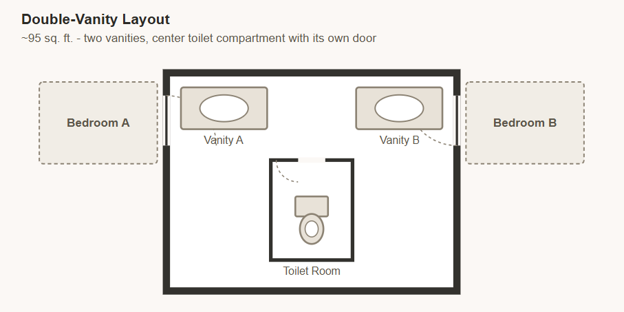
Double-vanity layout (roughly 95 sq. ft.): Two vanities flank the room, each near its respective bedroom door, with a separate toilet compartment behind a door in the center. This is the layout most remodel clients ask for because it directly solves the morning-conflict problem.
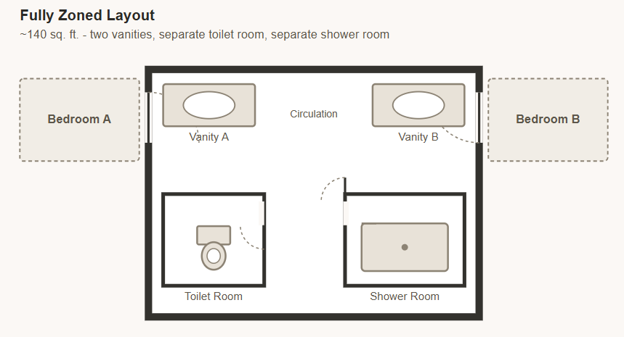
Fully zoned layout (roughly 140 sq. ft.): Two vanities, a separate toilet room, and a separate shower or tub room, connected by a small central circulation area. Both users can complete an entire routine without ever needing the other zone.
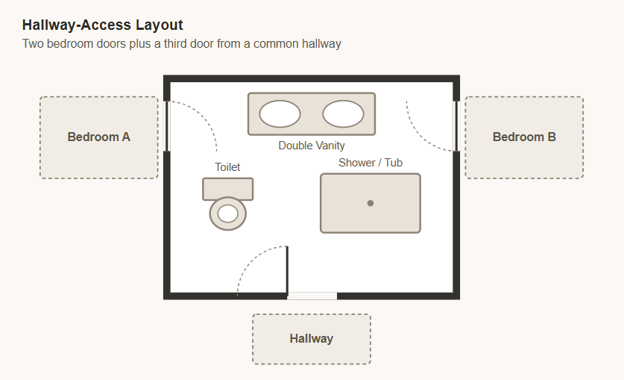
Hallway-access layout: Adds a third door from a common hallway to either the vanity area or the central circulation space, letting the room double as a guest bathroom when neither bedroom occupant is using it. This configuration is especially useful in homes without a dedicated powder room.
What makes each of these practical is not the square footage; it is whether the zoning matches how the two users actually live. A family with two young kids rarely needs the fully zoned version; two teenagers or adult roommates usually do.
CAD Drafters: Turning a Layout Idea Into a Buildable Plan
Sketching a Jack and Jill bathroom layout on paper is one thing, and getting it permit-ready and buildable is another. Door swings, fixture clearances, plumbing wall alignment, and ventilation requirements all have to work together on a real floor plan, not just an idea board.
This is where professional CAD drafting services come in. A drafter can take rough measurements or a hand sketch and turn it into an accurate, to-scale 2D floor plan or 3D layout that shows exactly how the doors, vanities, and fixtures fit together. For homeowners, this means seeing the layout clearly before committing to a contractor. For architects and builders, it means a coordinated set of drawings that can move straight into permitting and construction documentation.
This is particularly useful for a Jack and Jill bathroom because so much of its success depends on details that are hard to judge from a hand sketch: whether the two doors will actually clear each other, whether a double vanity fits without crowding the entry, or whether the plumbing wall can realistically support a separate toilet room without relocating the drain stack. A drafted plan catches those conflicts on paper, before framing starts, when changes are still cheap.
If you are planning a Jack and Jill bathroom remodel or a new build with this layout, working with a drafting service like CAD Drafting Company can help you go from a rough idea to an accurate, buildable floor plan without the guesswork, whether you need a single room layout, a full set of construction drawings, or 3D renderings to help visualize the finished space before construction begins.
Get an accurate Jack and Jill bathroom floor plan today.
Conclusion
A Jack and Jill bathroom is one of the most practical layouts in residential design when it is planned with real zoning in mind, such as separate vanities, a private toilet/shower area, and door placement that avoids conflict. It is not the right fit for every household, and the trade-offs around shared access and morning congestion are worth weighing honestly before committing.
Whether you are planning a new build or converting an existing layout, the difference between a bathroom that works and one that causes daily friction usually comes down to a few early planning decisions. Getting those details onto an accurate floor plan is the step that turns a good idea into a bathroom that actually holds up to two people’s daily routines.
Frequently Asked Questions
What is the minimum size for a Jack-and-Jill bathroom?
There is no universal code minimum specific to Jack-and-Jill bathrooms. Its size depends on the fixtures and zoning you choose. Compact versions can work in around 60 sq. ft., while fully separated layouts typically need 120 sq. ft. or more.
Do Jack and Jill bathrooms need two locks?
Most functional designs include a lock on each bedroom door and, ideally, a separate lock on the toilet/shower zone if it is partitioned off. That combination gives each user real privacy rather than just a closed door.
Can a Jack-and-Jill bathroom be converted into two separate bathrooms?
Yes, though it usually requires adding plumbing and reworking the wall between the two zones, which significantly increases costs compared to keeping the shared layout with better internal zoning.
Is a Jack-and-Jill bathroom good for resale value?
It can be, particularly in family-oriented markets where buyers value having a bathroom directly accessible from two bedrooms. A well-zoned version with double vanities tends to appeal more broadly than a single-vanity, single-zone layout.
What is the difference between a Jack and Jill bathroom and a shared bathroom between bedrooms with hallway access?
A true Jack-and-Jill bathroom connects directly to two bedrooms without requiring a hallway walk. A shared bathroom with hallway access may serve the same two bedrooms but is entered from a common hallway, which changes the privacy and traffic pattern.