If you’ve worked even one mid-size commercial job in the U.S., you’ve seen how a small coordination issue can turn into a very real cost and schedule problem. You can waste significant time in case of missing a sleeve, a conflicting beam web, or a late structural shift. Those issues happen because construction is fast, fragmented, and still too dependent on disconnected information handoffs.
That is exactly the gap virtual design and construction is built to solve. They support creating a reliable, shared virtual jobsite where teams can coordinate, sequence, quantify, and validate before the field pays the price. Let’s explore more about Virtual Design and Construction (VDC)!
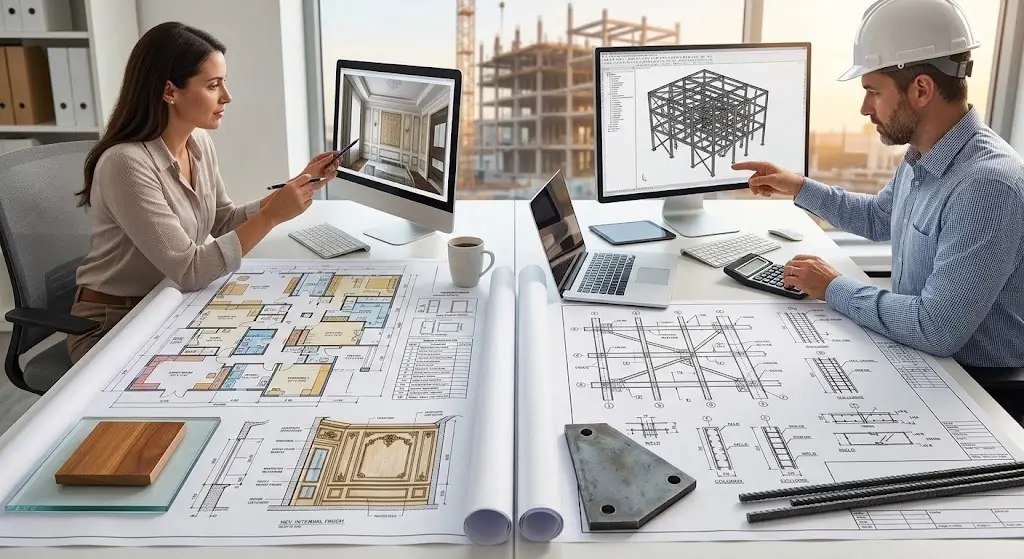
This level of pre-construction clarity is what separates standard design drawings from high-precision shop drawings, ensuring that every sleeve and beam is accounted for before fabrication begins
What Is VDC In Construction?
At its core, VDC is a management methodology that uses integrated project models to improve outcomes before and during construction by making decisions earlier, with better information.
As per Stanford/CIFE’s definition, Virtual Design and Construction (VDC) is the use of multidisciplinary performance models of design-construction projects. These include the Product (facility), Organization, Work Process, and even Total Economic Impact. The team uses this to support project objectives.
Regarding history, the VDC framework was developed at Stanford’s CIFE in 2001 and aims to improve planning, design, construction, and operation through combined management via objectives, collaboration methods, production management, and digital technologies.
Simply put, VDC is the disciplined way a team creates, governs, and uses project information so that design intent becomes a buildable scope. All is done with fewer conflicts, fewer changes, and tighter control of time and money.
While VDC is the management process, it relies on a foundation of what is BIM to provide the 3D data needed to reduce conflicts and control costs.
The Role Of VDC In Construction
VDC matters because it attacks the root causes behind many jobsite fires, including misaligned expectations, late information, and design/field disconnects. The NIST interoperability study, still one of the clearest signals of the cost of fragmented information exchange, estimated $15.8B per year in inadequate interoperability costs in the U.S. capital facilities industry (based on 2002 data). They also note these issues are tied to fragmentation, paper-based practices, lack of standardization, and inconsistent technology adoption.
If you are considering it as a technology problem, it is not. However, it shows up as:
- RFIs that should have been resolved in design coordination
- Rework from trades, discovering conflicts only after rough-in
- Procurement delays caused by unreliable quantities or late design direction
- Disputes about who owned a clash and when it was visible
The most valuable thing VDC brings is predictability: better coordination early, better decisions based on the same dataset, and fewer surprises when labor teams and materials hit the deck.
What Does VDC Include?
Most projects implementing virtual design and construction in a meaningful way include a combination of:
- Coordinated 3D models for architectural/structural/MEP, and sometimes civil and site utilities
- Formal clash detection and constructability review workflows
- Model-based quantity checks and procurement planning
- Construction sequencing simulations and a model linked to the schedule
- Structured issue tracking and decision logs, often in a common data environment
- Field validation through layout, scanning, and progressive as-built capture
The emphasis is not on the software; however, it’s on whether the team reliably converts model intelligence into fewer downstream disruptions.
Core Components Of Virtual Design & Construction
When VDC goes well, it’s because the team intentionally designs the information flow the same way they design the building. Going in depth, it means the task is done with clear responsibilities, defined reliability, and controlled handoffs.
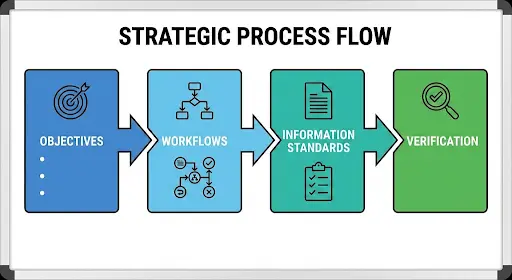
● Objectives & Measurable Outcomes
One reason VDC is frequently associated with Stanford/CIFE is that VDC is treated as a way to pursue explicit objectives and continuously measure whether the team is getting closer to them. CIFE’s guidance around VDC competency focuses on using VDC in ways that improve planning and management outcomes, like schedule and cost estimation.
On jobs, the objective language should be written in field-relevant terms, such as:
- Zero above-ceiling major clashes released for rough-in in Area A by X date
- MEP hanger points issued for layout two weeks before the deck pour in Zone 3
- Long-lead equipment rooms coordinated to fabrication level before submittal release
- Model-based quantities reconciled to estimate at the GMP milestone and at each design freeze
● People & Decision Structure
A lot of VDC failures are not modeling failures; they’re governance failures:
- No single point of coordination authority; everyone assumes someone else is driving
- Undefined turnaround expectations. Results: clashes pile up, and decisions stall
- Trades are not present when decisions are made, leading to later rework needs
On complex projects, VDC often works best when the team formalizes these points
- Who can make a decision?
- What information is required to make the decision?
- How does the decision get documented?
● Process & Production Planning
VDC becomes dramatically more valuable when it’s connected to production planning. Lean planning methods often pair well with VDC because they force teams to address constraints before releasing the work.
For example, the Lean Construction Institute describes the Last Planner System as focused on maintaining flow by promoting conversations to identify problems before they interrupt production, using pull planning and related planning conversations.
In practical terms, that means VDC isn’t only find clashes. It also answers:
- Is this area actually ready for rough-in?
- Are submittals aligned with coordination outcomes?
- Is the latest model actually the one the field should build from?
● Information Reliability & Authorized Use
Do you know the most common problem in this game? Its models look precise, so downstream users rely on them, while the model author never intended that level of reliance. Therefore, contract and protocol language matters.
The AIA Digital Practice guidance explains that, rather than covering, Authorized Uses define what information others can rely on. This prevents unintended reliance. It also describes that the G202 Model Element Table supports defining Authorized Uses model element-by-model element and milestone-by-milestone.
In other words, VDC benefits increase when the team clearly states what the model is reliable for at each milestone.
Defining what a model is reliable for at each milestone is best managed by selecting the right LOD for your BIM project to ensure data accuracy for all stakeholders.
A Simple VDC Information Workflow
Below is a view of how VDC supports production:
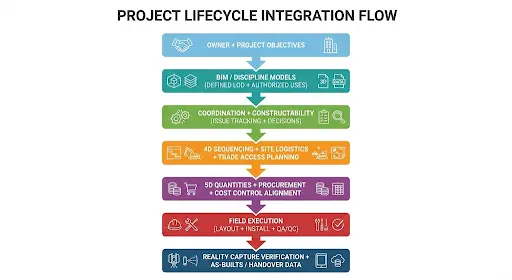
This is not one linear step. Reliable teams loop back continuously as design changes, procurement realities shift, or field conditions require adjustments.
The Difference Between VDC and BIM
VDC and BIM are two of the most misunderstood topics in the industry, mainly because people use the terms interchangeably when they shouldn’t.
What Is BIM?
The National Institute of Building Sciences defines Building Information Modeling (BIM) as a digital representation of physical and functional characteristics of a facility. This serves as a shared knowledge resource and reliable basis for decisions during the facility lifecycle. The study also emphasizes collaboration across stakeholders who insert/extract/update information in the BIM.
NBIMS further notes that the team should base BIM interchanges on shared digital representation, interoperability (computer-to-computer exchanges), open standards, and requirements that the team can define in contract language.
What Is VDC?
VDC is broader than BIM. The Stanford/CIFE definition emphasizes multidisciplinary performance models, including product, organization, and process modeling, and ties that to total economic impact and stakeholder realities.
Academic reviews similarly describe VDC as a project-management framework built to integrate objectives, collaboration, and production management with digital technologies.
VDC Vs BIM
BIM is the facility information model, or you can say the digital representation and data container. On the other hand, VDC is the management system that uses BIM, schedule, cost, workflows, and governance to produce predictable project outcomes.
The Benefits Of VDC Projects
The value of VDC is not that it makes a nice to look model. However, the value is that it reduces the expensive types of uncertainty that cause real downstream cost. In other words, this eliminates rework, delays, claims, and procurement issues. Let’s understand them in detail!
● Fewer Field Conflicts & Less Rework
The AGC Contractors Guide to BIM describes contractor benefits, such as identifying collisions, visualizing what will be built in a simulated environment, and achieving fewer errors and corrections in the field. Additionally, it enables more prefabrication when conditions are more reliable.
This aligns with how field leaders think, like fewer surprises above ceiling, fewer cut and patch, fewer quick drills right before an inspection.
● Better Prefabrication Readiness
Prefabrication isn’t just a shop choice. It depends on information readiness, including:
- Accurate penetrations and embeds
- Coordinated hanger locations
- Stable routing and clearances
- Complete spooling packages
AGC notes that higher reliability of expected field conditions allows opportunities for more prefabrication, which is often higher quality at lower cost.
● Clearer Alignment Between Achedule & Constraints
When VDC is connected to production planning, teams can sequence work based on constraints. Lean methods, like pull planning, seek to ensure materials, people, information, and equipment arrive when needed to maintain flow. This reduces stop-start inefficiency.
● Stronger Cost & Schedule Risk Control Through 4D/5D Models
Many teams talk about 4D and 5D as if they’re separate products. The AGC guide describes 4D as adding time/schedule data to the model and 5D as adding quantities and cost information. It also points out that these are simply extensions of how a team can use 3D tools for planning, design, construction, and operations.
When the model is linked to time and quantities in a disciplined way, it becomes easier to:
- Validate phasing plans and trade stacking
- See access conflicts before they happen
- Forecast procurement needs andworkforcer loading
- Test what-if scenarios under real limitations
● Better Handover & Facility Data Capture
NIBS describes COBie (Construction Operations Building Information Exchange) as a specification that standardizes how data used to manage and maintain facility assets is organized. This combines schedule-type information and as-built/O&M/commissioning info captured during construction so that owners can populate maintenance systems more quickly and accurately.
WBDG further explains the problem COBie was designed to solve: owners repeatedly collect and transcribe operations information across a project, often losing it in the process. And COBie proposed a structured approach to provide electronic O&M and asset management information as it is created.
Achieving high prefabrication readiness requires a precise VDC workflow, especially when generating a complete pipe spool package for off-site manufacturing.
How Does VDC Improve Planning & Support Execution?
In preconstruction, virtual design and construction directly support decisions that contractors actually care about:
- Can we commit to a target schedule with known constraints?
- Is our estimate aligned with what’s actually designed (and what’s missing)?
- What’s the procurement strategy for long-lead items?
- What’s the prefabrication plan, and what information is required to fabricate?
Here is a practical planning workflow that many teams follow:
- Define the model uses and strategy. Penn State’s BIM planning resources emphasize that there are many uses for BIM and that structured planning helps teams clarify the precise purpose and context of implementing model-based methods.
- Give notes on information reliability. The BIMForum LOD Specification is explicitly designed to help practitioners articulate model content and reliability clearly. This makes model authors define what models can be relied on for, and downstream users understand limitations.
- Define authorized uses and responsibilities. AIA’s Digital Practice guidance explains the intent of Authorized Uses and how the G202 Model Element Table supports defining them by milestone, helping prevent unintended reliance.
Role Of VDC During Construction Execution
In construction, VDC moves from coordination into supporting installation and verifying reality.
Here is a field-realistic view of VDC in an execution plan:
- Layout-ready information, giving information on hanger points, sleeves, and penetrations, embeds
- Install packages, including spools, deck penetration drawings, and area release plans
- Continuous issue closure means every open clash has an owner and a due date
- Verification loops mean scanning or other reality capture validates critical work before close-in
Technologies Used in VDC
VDC is a methodology, but professionals use many tools to run it. In 2026, the winning tech stack is usually the one that reduces friction, which means fewer exports, clearer version control, and faster issue closure.
● Model Coordination & Clash Resolution Tools
Most teams rely on an aggregated model review to identify overlaps early. Autodesk’s Navisworks learning content, for instance, explicitly frames using aggregated models to identify overlaps early to reduce rework and costs.
Tools..
- Federate models consistently
- Define clash test rules, explaining what counts as a clash vs allowed contact.
- Document decisions and close them
- Keep the field coordinated with current decisions
● 4D Sequencing & Schedule Visualization
4D helps teams answer:
- Can we physically build it in the planned sequence?
- Do we have access to the crane paths?
- Are multiple trades stacked in a way that will force rework?
AGC’s guide explains the 4D concept as integrating schedule/time data with model data as an extended application of the 3D tool.
● 5D Quantities & Cost Alignment
5D is valuable when it ties model quantities to estimate codes, procurement packages, or cost reporting structures. AGC describes 5D as applying quantity and cost information using model data, again, as an extension of how the 3D tool can improve processes.
Note: Model quantities are only as good as the modeling standards and QA. If teams don’t define what is included or excluded, they can experience the results of false confidence.
● Reality Capture & Verification
If you’re serious about virtual construction, you need a way to reconcile designed vs installed. LiDAR and point clouds are common inputs for verification. USGS explains that LiDAR reflections can be recorded as millions of individual points representing 3D positions of objects, including buildings and the ground.
You don’t need to scan everything. High-value scanning targets include:
- MEP racks before insulation/close-in
- structural embeds and sleeves before pours
- tight above-ceiling zones before grid installation
● Digital As-Builts & Digital Twin Direction
Public agencies are pushing toward durable digital records. FHWA defines a digital as-built as a digital record of constructed condition that is electronic, searchable, extractable, and durable. In the same document, they describe a digital twin as a digital representation of an asset connected to inventory, condition, and performance information.
Furthermore, NIBS focuses on integrating BIM and digital twin technology for the built environment. They describe it as an opportunity for innovation, efficiency, collaboration, and improved operational performance.
VDC Implementation Challenges & Their Solutions
If VDC was easy, everyone would already be doing it well. Most VDC failures are predictable and preventable. Below are some common issues with solutions.
● Contract & Liability Uncertainty
The biggest friction point is often reliance. This is who can rely on the model, for what, and when? The AIA Digital Practice guidance addresses this problem by explaining Authorized Uses and how they prevent unintended reliance. It also clarifies that model users may rely only on what is consistent with the stated LOD at a given milestone, even if a model element contains more detail.
● Model Looks Right, But Isn’t Buildable
Constructability is not the same as geometry. A model can pass clash detection and still be unbuildable because of:
- Access for installation and maintenance
- Trade means-and-methods conflicts
- Code-required clearances that aren’t modeled consistently
- Sequencing constraints
To fix it, you should add constructability reviews and trade input early, not late.
● Information Management & Version Control
A huge percentage of coordination waste is not a design error; however, it’s teams working from the wrong version. Therefore, a central controlled environment and clear approval states matter. Even where teams don’t fully formalize ISO workflows, the core principle is consistent, meaning one source of truth, distribution control, and clear status labeling.
● Interoperability & Data Loss
NIST reports how fragmented practices and inconsistent technology adoption contribute to inefficiency and cost. During construction, interoperability shows up as:
- Lost parameters when exporting models
- Inconsistent naming conventions and object classification
- Duplicated effort rebuilding models for each stakeholder
Experienced teams reduce this by using open standards where required and by standardizing object libraries, naming, and deliverable definitions.
● Change Management & Training
VDC touches estimators, PMs, supers, supervisors, coordinators, and designers. If you treat VDC as the BIM team’s thing, it won’t shift outcomes.
The best training is job-embedded:
- VDC initiation aligned to the actual schedule.
- Short weekly lessons tied to immediate coordination needs.
- Field feedback loops on what was missing and what helped.
● Safety & Quality Integration
VDC can support safer planning by identifying high-risk sequences and reducing issues in congested areas. OSHA emphasizes that structured safety and health programs are associated with higher-quality output and better results in many employers’ experience. This shows that planning and management systems can influence outcomes.
OSHA’s mission is to assure safe and healthful working conditions for workers. This is a reminder that if VDC can simplify execution and reduce last-minute improvisation, it can support safer operations.
Managing reliance and liability starts with a clear definition of the right LOD for your BIM project, ensuring every stakeholder knows exactly what data is authorized for use.
The Future Of Virtual Construction
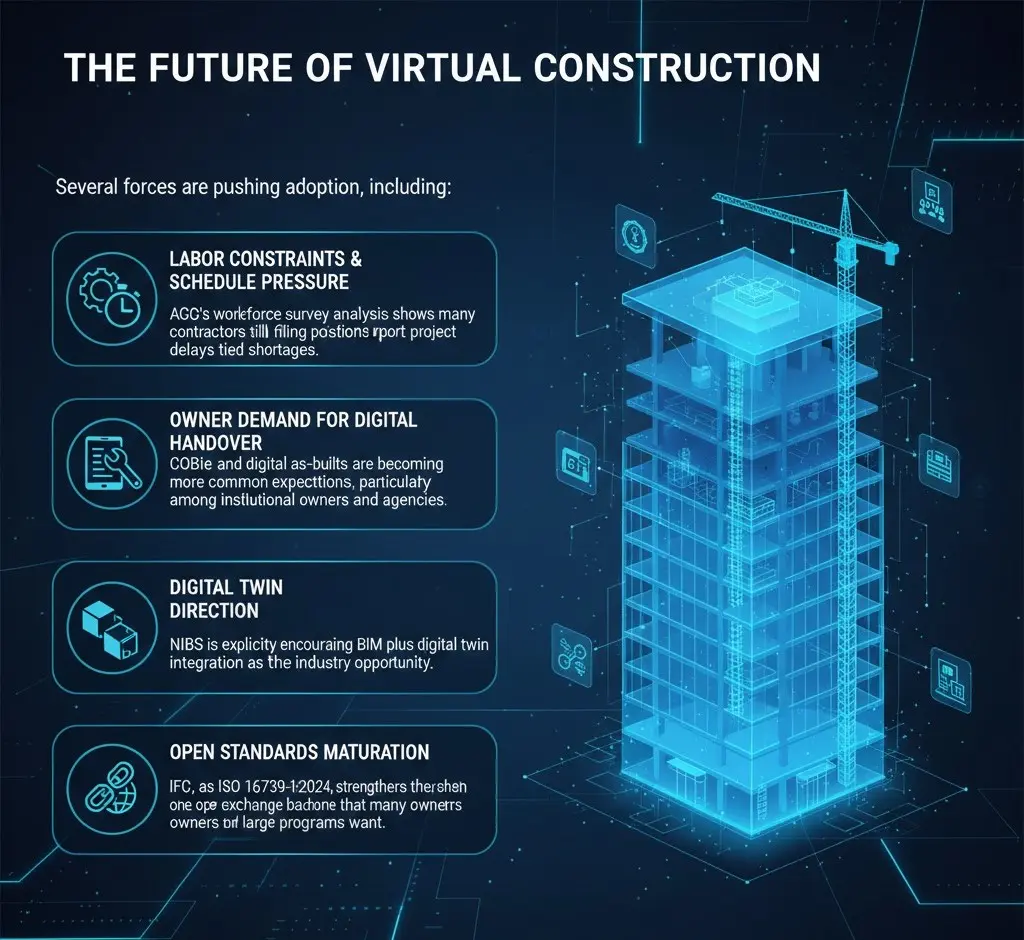
Several forces are pushing adoption, including:
● Labor Constraints & Schedule Pressure
AGC’s workforce survey analysis shows many contractors still have difficulty filling positions and report project delays tied to shortages.
● Owner Demand For Digital Handover
COBie and digital as-builts are becoming more common expectations, particularly among institutional owners and agencies.
● Digital Twin Direction
NIBS is explicitly encouraging BIM plus digital twin integration as an industry opportunity.
● Open Standards Maturation
IFC, as ISO 16739-1:202,4 strengthens the open exchange backbone that many owners and large programs want.
Why Construction Companies Are Adopting VDC In 2026?
On the contractor side, adoption is less about innovation and more about reducing controllable risk, like:
- Fewer RFIs and change events tied to coordination misses
- More stable labor productivity through better planning
- Improved prefabrication feasibility
- Improved ability to manage the complexity of projects
In other words, VDC is increasingly a competitive necessity on complex projects, because it reduces avoidable mess.
Unlock Your VDC Competitive Advantage
Frequently Asked Questions
What is a useful way to test whether a team is doing VDC or BIM?
Ask them:
- Do we have measurable objectives tied to the model?
- Do we link coordination decisions to schedule/procurement constraints?
- Do we verify field execution against the model and close the loop?
If the answer is NO, you likely have BIM deliverables, but not full virtual construction.
Is VDC only for big projects?
No. VDC scales. Smaller projects often use a targeted VDC approach. This means it focuses on the riser or shaft zones, equipment rooms, above-ceiling corridor runs, and any area with multiple trades stacked in a tight space.
What deliverables should you require in VDC?
Ask for:
- A coordination schedule and issue-management process
- Defined LOD and Authorized Uses by milestone
- Clash test rules and a closure log
- Model version control rules
- Field-deployable outputs, including layout points, sleeve/penetration drawings, spools, or install packages as applicable.
Does VDC replace schedules like Primavera or MS Project?
No. VDC complements scheduling by improving the constructability of the planned sequence and helping teams visualize constraints. AGC’s guidance frames 4D as integrating schedule/time data with model data, an extension of model use, not a replacement for CPM scheduling.
What’s the difference between digital as-builts and digital twins?
FHWA describes digital as-builts as durable, searchable, extractable digital records of the constructed condition in an electronic format. FHWA also describes a digital twin as a digital representation of an asset connected to inventory, condition, and performance information.
How do open standards matter in VDC?
Open standards reduce friction and improve the durability of information across software ecosystems. buildingSMART describes IFC as a vendor-neutral, open international standard intended to work across platforms.
How to know if your VDC program is working?
Track things the field leadership cares about:
- Number of major clashes found before install
- Percent of coordination issues closed before rough-in release
- RFI volume in coordinated zones
- Rework events tied to coordination.
Conclusion
For 2026, the clearest definition of VDC is simple: a project team that can make buildable decisions earlier, and prove those decisions in the field with fewer surprises. Achieving that requires more than a BIM model; it requires defined objectives, controlled information reliability, strong coordination governance, and feedback loops that keep the virtual plan aligned with jobsite reality.
If you need assistance in this whole game, CAD Drafters supports U.S. builders with BIM/CAD drafting, clash coordination, shop drawings, and quantity takeoffs that plug into your virtual design and construction workflow. Our team builds models, sheets, and coordination logs so that you can prefabricate, plan, and build with confidence in the field. Request a VDC support quote today!