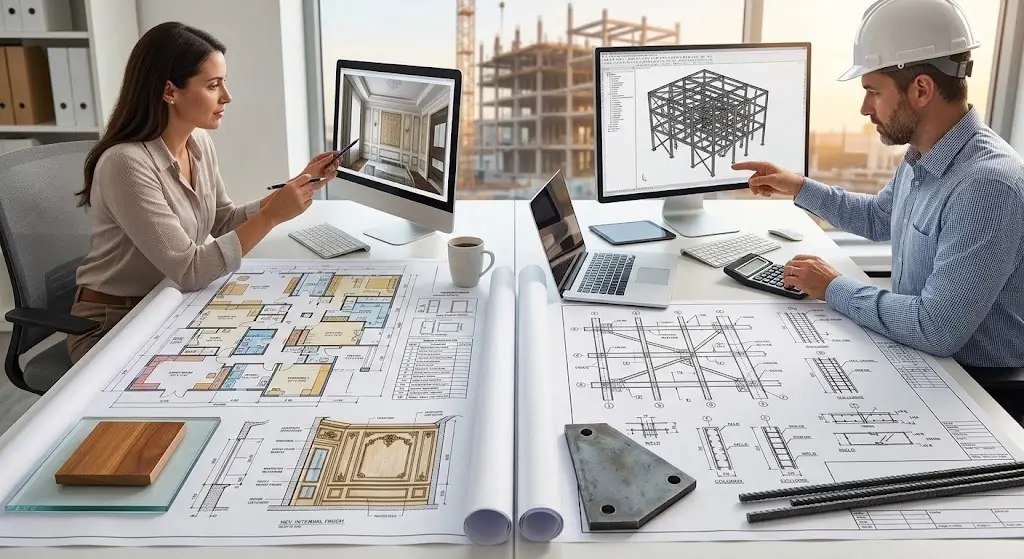
Conceptual designs are the backbone of engineering and drafting. Every line you draw in conceptual work determines the scope and budget of your project. Industry research indicates that decisions made during the conceptual phase influence up to 70% of the total project cost, making early-stage accuracy vital for budget management. Consequently, whether you are specialized in civil, electrical, or mechanical engineering, or drafting fields, your initial designs are critical for a successful outcome.
This guide explores how conceptual development minimizes costly revisions and optimizes project efficiency.
What is Conceptual Design?
This represents the preliminary phase where engineers and architects establish a project’s framework to streamline subsequent workflows, including schematic design and final construction documentation.
What is Conceptual Design in Engineering & Drafting?
This is the phase in which architects and engineers focus on creativity, identifying needs, and analyzing their ideas rather than just taking the right measurements for engineering and drafting. During this phase, designers develop preliminary sketches to visualize spatial requirements and evaluate the project’s physical form.
Understanding Conceptual Design with Example
The initial design is the point that makes the difference between a smooth and a difficult project. It also helps determine the total cost of the projects before starting, which improves cost and quality control. In addition, it is the initial stage where engineers explore different ideas and possibilities according to the technical requirements, and decide to finalize one of them that is most suitable. By investing time in conceptual design, architects and engineers can set the right direction and goals for the project.
Let’s clear it with an example.
Commencing a construction project without a validated concept often leads to immediate site conflicts and suboptimal project outcomes. On-site confusion starts on the first day. There are unclear instructions for workers regarding what needs to be built, in what order, and to what specifications. Conflicts between trades result from this. In the case of plumbing lines, they can be installed where structural beams will be introduced later, thus causing costly demolition and repair works. But when you have a conceptualized idea, and you sketch it on paper, it will be easy to draft and achieve a more productive and streamlined outcome.
Importance of Conceptual Designs
- Allows you to set project goals and define requirements.
- Helps avoid costly mistakes during drafting and reduces redesigns in the construction process.
- Identifies problems and enables you to find effective solutions.
- Improves communication and avoids losses due to misunderstandings.
- Promotes innovative thinking and explores different ideas.
The Step-by-Step Conceptual Design Process
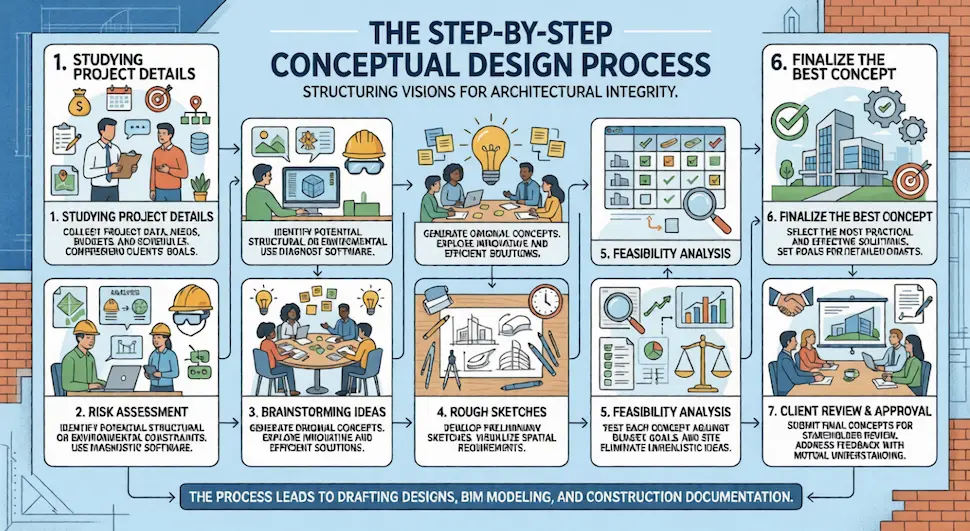
Architectural integrity relies on a structured design methodology that bridges the gap between vision and execution. There is a strong process behind it that architects and engineers must follow. This process starts from the concept design formulation, drafting designs, BIM modeling, and the final construction documentation.
Studying the Project Details
To be able to fully comprehend clients’ goals, designers first collect project data, needs, budgets, and schedules. For a solid, precise basis in engineering and drafting, this is essential.
Risk Assessment
Engineers utilize diagnostic software and site analysis to identify potential structural or environmental constraints before formal drafting begins.
Brainstorming Idea
Designers come up with a variety of original and imaginative project-related concepts and freely explore them. This helps in approaching the best and most efficient solutions that fit the project’s objectives and financial limitations.
Rough Sketches
Then, rough sketches are made based on the different solutions so that they can be visualized closely and compared with each other. This not only clarifies the concept but also makes it easier for engineers to understand.
Feasibility Analysis
In this phase, each concept of designing is tested against the budget, goals, and site requirements to determine which ideas will work for the project and which are unrealistic. This helps eliminate unnecessary concepts and enables focus on reliable concepts.
Finalize the Best Concept
Engineers select appropriate solutions that not only look effective but are also practical for the project. This also improves clarity and sets goals that help in developing detailed drafts.
Client Review and Approval
Final concepts are sent to the project stakeholders for their final review. If they want to change something, it is done with mutual understanding. So that the final drafting can satisfy the clients and help the contractors on the site with a smooth planning, this also brings clarity and usefulness.
Conceptual Design vs. Detailed Design
If you want to understand the conceptual or detailed design, here is a table below.
| Aspects | Conceptual Design | Detailed Design |
| Purpose | to create the project’s first concepts and overall vision | To produce construction-ready specs and drawings |
| Focus | Innovation, concepts, and opportunities | Execution, precision, and technical details |
| Flexibility | flexible and easy to modify concepts | modifications are expensive and time-consuming |
| Time Required | Shorter duration | Longer duration |
| Risk Level | More assumptions and greater inconsistencies | based on verified data |
| Tools Used | Basic CAD Software | Advanced CAD and BIM tools |
| Stage In Process | Initial preparation for drafting | Final designing before construction or production |
| Key Stakeholders | Designers, lead engineers, and project owners. | Draftsman and specialists |
| Outcome | Accurate design direction and approved concepts | Clear roadmap and fully buildable project plan |
Why Does Precision Matter in Initial Design?
- If conceptual design engineering is accurate, it helps in a better understanding of projects.
- Removes confusion among engineers and stakeholders.
- Supports in making the best decision to select the idea for the project.
- By starting with accuracy, it saves time by avoiding repeated corrections.
- It provides the best structure for detailed design.
- It ensures meeting building standards and legal regulations.
- Reduces miscommunication and strengthens collaboration.
- Streamlines the process from concept to execution.
Major Mistake in Conceptual Design that Ought to be Stopped
- The most common error made by architects is to promote a single concept rather than investigate alternative ideas and solutions.
- Today’s engineers prioritize aesthetics over functionality and performance.
- Making a wrong decision can result in delays and rework.
- Some drafters neglect the analysis of site conditions, which can cause problems during implementation.
- Avoid over-engineering: Striving for absolute perfection in the conceptual phase can lead to unnecessary complexity that hinders downstream execution.
Essential Tools for Conceptual Design & Development
Hand Sketching Tools
Pencils, markers, and scales play important roles in the hand sketching process. This helps to roughly draw ideas and also allows for quick changes to anything.
CAD Software
CAD tools are of great help when it comes to converting raw ideas into digital drawings. Digital tools not only streamline the conceptual phase but also allow for rapid iterations and precise editing.
Site Surveying Tools
Laser distance meters and clinometers allow for precise site measurements, ensuring that the digital concept aligns with physical constraints.
Visualization Software
This software helps visualize the selected idea on the screen, so that stakeholders can understand the final form and its functions.
Why wait for the construction phase to find errors? We use advanced CAD and visualization tools to spot risks early and streamline your project from day one. Let’s start your conceptual journey with accuracy.
Conclusion
A successful detailed design relies on a strong and clear conceptual design. Therefore, you must begin the initial design with a full understanding of the project requirements, site conditions, and the client’s unique demands so that no information is left out, which can create obstacles. In simple words, we can say that strong concepts and ideas bring the desired results.
In today’s modern era, engineers should consider initial design before developing detailed drafts to avoid unexpected obstacles, revisions, and unsatisfactory situations. If you invest your time in early design, you can not only improve the accuracy of the drawing and project efficiency but also strengthen the collaboration and reputation.
FAQs
What does conceptual design require?
The basic information that architects and engineers need for initial design in drafting and engineering is the project goals, design, client brief, and site requirements.
Is it easy to make changes in initial design?
Yes, since this is an initial plan, it may not take much time or cost to change anything in the design.
How can conceptual design manage risks?
In these designs, architects identify risk factors in the early stages and address them before the project begins. It also eliminates bottlenecks and problems from the process.
How can we find the best idea from the selected concepts?
You need to compare all the selected concepts based on the project requirements, budget, and timeline. The concept that best balances the overall project requirements, budget, and timeline is typically selected for development.