3D interior animation transforms abstract designs into immersive experiences by creating a moving, video-like walkthrough of a space.
Inability to picture a space slows down the construction or remodeling projects. You may consider a single picture, but it never tells a complete story, and leaves you blank regarding circulation, scale, and how a room actually feels. And it is where 3D interior animation is winning in the industry.
3D interior animation gives a picture movement, sequence, and context, and also makes design intent easier to read. This means fewer misunderstandings, fewer second-round explanations, and fewer revisions. Let’s explore more on this!
What is 3D Interior Animation?
3D interior animation (also called 3D virtual tours, cinematic animation, interior walkthrough, interior flythrough, and architectural animation) is a moving visual presentation of an interior space. It usually follows a camera path through a modeled room, suite, lobby, office, or apartment. The viewer sees the layout unfold in sequence, instead of trying to decode one frozen frame.
A rendering shows one moment, while an animation shows relationships between different rooms and components. In animations, you can see how the dining and kitchen connect, how the lights lit the surface, and how furniture setting affects circulation. Plus, they are built from a sequence of frames, which is why video has a different communication value than a static image (traditional rendering).
In archviz (architectural visualization) terms, that motion adds spatial logic, which means the fundamental rules of geometry, perspective, and physics that dictate how objects, cameras, and characters exist and interact within a virtual 3D environment.
Today, experts joined forces of 3D animation and BIM. The team providing 3D visualization services takes the model, the materials, and the lighting setup and turns them into a story that everyone can follow without effort. And this is where a technical step is converted into a foundation for a video presentation.
How Does Architectural Animation Work?
It is a detailed process from 3D modeling to rendering. Explore the complete workflow below:
-
Collecting Data & Setting Layout
Experts first utilize CAD, BIM, or conceptual drawings to clearly define the scope of the project. It is where they establish exact architectural dimensions and spatial flow.
-
3D Modeling & Optimization
Next, the team imports CAD/BIM data into 3D software like 3ds Max or Blender and cleans up the geometry to remove unnecessary background data.
-
Texturing & Environment
Then comes the phase that makes the space feel alive. Experts layer in photorealistic materials, like wood, concrete, glass, plus lighting setups, fixtures, and interior furniture.
-
Camera Path & Animation
Next, teams carefully pre-visualize an animation through a sequence of drawings, graphic organizers, or digital panels.
-
Rendering & Post-Production
Using the suitable software, the teams assess every frame, light ray, and reflection. Last, they integrate the rendered frames into post-production software, like Adobe Premiere or After Effects. It is done with color grading, sound design, and voiceovers.
Before starting animation, teams outsource 3D floor plan rendering services to give the client a top-down understanding of flow, room adjacency, and scale. Once the plan makes sense, the walkthrough becomes easier to control and optimize.
Remember that version control means a lot during this workflow. A bad model will produce a bad animation. It is where industry experts suggest architectural drafting services to get better motion output.
Why Design Firms Use 3D Interior Animation?
Better visualization, hassle-free client approval, flawless communication, strong marketing & sales and unmatched control.
How Does 3D Interior Animation Support Better Visualization and Realism?
In animations, a design firm’s clients do not experience interiors as static images. However, they move through them, which means a natural feel. The animation recreates the sequence of seeing a space, turning a corner, and noticing how zones connect.
With strong 3D rendering services, one can make the visuals look believable for clients. But with animation, you can add the timing that makes the room feel occupied. In other words, you can decide where the chair should be, the paint shade of the wall, the features of the ceilings, etc. These types of details are essential, particularly for atmospheric-sensitive spaces, like hospitality suites and workplace lobbies.
How Does a 3D Virtual Tour Speed Approvals?
As an interior designing expert, you understand that project approvals slow down when clients have to assemble the project mentally. And static images often force that work onto them. With animations, you can avoid this issue.
When the camera moves through the plan, clients see the sequences clearly. They understand where one room leads into another, how wide a passage is, and whether a focal wall is where it should be. This level of detail removes rework from the designing phase of the project as well as speeds up the approval process.
Additionally, it is where design firms combine two forces: drafting and animation. They support animations with interior design drafting services from industry experts. The drawing sets the geometry, and the animation makes that geometry cohesive.
How Does Cinematic Animation Improve Communication?
You know that many of the design issues arise from the vocabulary/dictionary. Mostly, clients use words like open, clean, and warm when sharing their space demands. But those words can mean different things for different teams working on the same project. It is where animations replace the game of words with clear interior walkthroughs.
Instead of debating a section line or a material schedule, one can see how the space behaves. They can track sightlines, furniture spacing, and transitions between public and private zones. That is useful in residential work, but it becomes essential in commercial interiors where layout affects the circulation and function.
How Does Architectural Animation Improve Marketing and Sales?
In 2026, the construction industry has shifted to 15-sec short clips, interactive links, and live-in visual storytelling. Why? Because images stop the scroll, but animation captures attention. And this is how design firms now market their services and improve sales.
Designers now feature a lobby sequence on a website banner and support a social post with a kitchen walkthrough. Additionally, they benefit from 3D furniture rendering services to add detailed furnishings, making the space feel more specific instead of generic.
How Does Interior Flythrough Support Better Control?
Animation does something delicate. By only watching them, you can feel a sense of control. When the camera moves, showing you a video, you can pause it on any key details and reveal the space in logical order. And this gives a project rhythm, as well as gives the presentation a clean structure, which helps teams discuss the same idea without conflicting points.
3D Interior Animation Vs Traditional Renderings
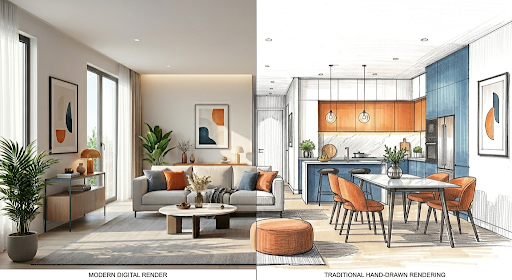
For you, traditional 3D architectural rendering might be outdated. However, they are just limited. They still work best when your goal is to show one highly controlled moment. Animation works better when the goal is to explain how a space functions.
Explore the difference between 3D interior animation and traditional rendering in the table below!
| Criterion | 3D Interior Animation | Traditional Rendering |
| Output format | Video walkthrough | Static still image |
| Realism | Shows movement, depth, and transitions | Shows a single polished frame |
| Design Communication | Communicate circulation paths, natural light movement, material transitions, and sequences of spaces | Communicate material quality, surface finish, fixture detail, and lighting mood |
| Revision Flexibility | Costly to revise mid-production | Individual views can be updated independently |
| Accuracy | High when modeled correctly, but the moving camera can hide some specific dimensional or material details | High precision per view; orthographic-style renders or annotated stills serve well as design reference |
| Delivery | MP4/MOV video file, paired with a social-media cut and a full-length version | High-res JPEG or TIFF, compiled into a PDF presentation board |
| Software |
|
|
Is Animation Better than Rendering?
YES, when the goal is explanation, approval, or marketing. And NO, when the goal is speed, budget control, or one polished frame for a brochure. A static rendering is enough when you need a quick hero image, a material close-up, or a clear visual for a proposal cover. And in animations, you get a deep look into the space with moving objects.
So, what is better for you depends on what your project demands and what your client needs to understand. If it is in the mood, go with rendering, which is an affordable option. However, if it is movement, flow, and spatial logic, animations should be your choice.
When to Use Rendering & When to Use Animation?
Use rendering:
- During the design phase
- When the project budget is tight
- While working on materials and finishes
- For print and web portfolios
Use 3D animations:
- To understand flow and layouts
- When selling non-ground buildings
- When raising capital
- To design high-budget projects
Use both when:
- Bridging the gap between imagination and reality
Conclusion
3D interior animation does more than make a project look polished. It makes the design easier to read; that is the real advantage. It helps clients understand space faster, gives firms a hassle-free approval path, and creates stronger marketing assets.
Remember that static renderings still matter as they do narrower jobs. Animation steps in when the project needs flow, timing, and context. Therefore, many designing firms consider animation as part of the presentation toolkit, along with modeling and drafting.
If you are an interior designer, contractor, or architect, make your presentation stand out with result-generating services offered by CAD Drafters. We convert technical drawings into high-quality visuals that your client can easily understand.
Get High Quality 3D Visualization Services Now!
FAQs
What is meant by 3D interior animation?
3D interior animation is a moving visual of an interior space. It follows a camera through a modeled room or building so that you can understand layout, scale, and atmosphere.
Is animation more expensive than rendering?
Yes. Animation takes more production time because it includes camera paths, more frames, and more post-work. But it can lower the total project cost when it reduces confusion, revision cycles, and approval delays.
What should a design firm look for in a good animation partner?
Look for clean modeling, accurate drafting, believable materials, and a strong sense of pacing. A good partner should understand how to turn technical design information into visuals that clients can read easily.
Why should I rely on experts for 3D interior animation services?
Use industry experts’ 3D interior animation services to ensure better client understanding and improved design communication. You can also save time and a lot of money by taking this approach into consideration.