Developers and owners must be aware of the full process for obtaining the permit before starting construction. If you start the construction project without the permit being approved, you’ll face trouble during the process, such as demolition orders, delays, and penalties. Getting the permits approved is more than just paperwork. These permits look at every component of the project to ensure that it meets the codes and standards set by the local authorities.
Regardless of whether the project is residential, commercial, or a renovation project, you will have to get the permit approval before starting the construction. Knowing every step of the permit process helps the developers save extra costs and ensure timely project completion. This guide will help you understand the complete process, the cost of getting a construction permit, and the permit type in detail.
To better understand how construction approvals and documentation work together, check out our detailed guide on construction documents.
What is a Building Permit?
A building permit is an official approval that is issued by the local authorities, in which they allow the construction, renovation, and demolition process. They make sure the construction or demolition process follows the legal requirements. It is to ensure that the proposed work complies with the standard safety measures and building codes. Whether a project needs a building permit depends on local rules. Small or non-permanent structures, like sheds under 120–200 square feet, are often exempt.
Scope of Work Covered
Any sort of work that affects the stability and functionality of the building, like electrical, plumbing, or mechanical equipment installation or removal, needs a permit before starting the project. Whether it’s a completely new construction project or renovation, the permit ensures adherence to safety standards. Permits cover both modifications to the existing structure and the new construction.
Technical Review and Compliance Check
A building permit acts as a checkpoint system. It ensures the construction follows safety standards. The project must meet energy efficiency and ventilation requirements. Proper drainage must be in place. Mechanical, electrical, and plumbing systems should not intersect. Each system must work without affecting the others. Authorities carefully check that the structure of the building and its every component align well with the local codes before approving the permit.
Inspection and Quality Control
Getting the permit approval is not the end of the process. The government makes sure that all the approved plans are followed during the construction process. To ensure this step, the inspector monitors the construction process at different stages. Inspectors visit the site to verify that no unsafe practices occur during the construction process, or else demolition or orders to stop the construction process are issued.
Legal and Financial Implications
No matter how well the drawings are prepared and the structures are made, if there are any legal and financial implications in the project, it will lead to fines, forced legal modifications in the design, and even the owner faces issues when selling that property because of the legal notice on that specific project. If authorities find anything unlawful, and the construction involves non-standard measures, it may require the removal or demolition of that unauthorized construction.
To gain a clearer understanding of how electrical, mechanical, and plumbing systems are planned and coordinated in construction, explore our guide on MEP in construction.
Types of Building Permits
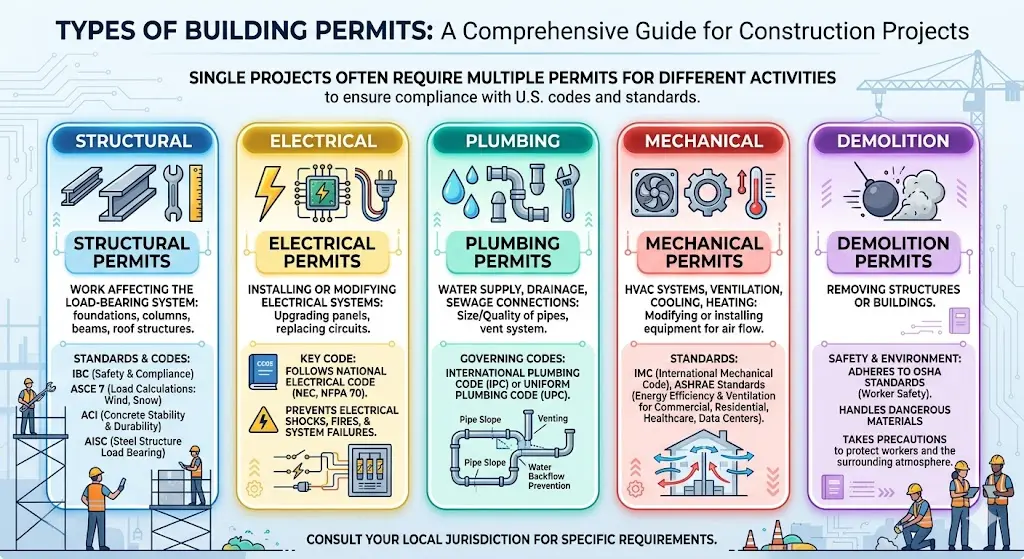
Construction on a single project requires permit approvals for different activities. Contrary to common belief, a single permit rarely covers all aspects of a project. Each permit focuses on a specific component to ensure compliance, safety, and the measures that should be used during construction, which are proposed under U.S. codes and standards.
Structural Permits
Structural permits are required for any work that affects the load-bearing system of a building, such as foundations, columns, beams, slabs, and roof structures. In this permit, authorities specifically review the structure and how much load it needs to bear, and the specific material used for the construction is of good quality to support the load.
- Structural design in the United States is reviewed under the International Building Code (IBC) to ensure the building’s safety and compliance.
- Load calculations are performed according to ASCE 7 (American Society of Civil Engineers) standards for wind, snow, and other natural or structural loads.
- Concrete design follows ACI (American Concrete Institute) codes to ensure the building’s stability and durability for a long period of time.
- Steel structures are designed based on AISC (American Institute of Steel Construction) standards. It is to make sure the structure can bear the load and hold the project structure in its position.
Electrical Permits
Electrical permits are needed to start any electrical activity in the building, whether it’s installing the new electrical system, upgrading the panels, or replacing the circuits. Electrical work in the U.S. must follow the National Electrical Code (NEC), published by the National Fire Protection Association (NFPA 70). The government verifies that these codes are being followed during the construction project from time to time. These NEC standards help prevent electrical shocks, fires, and system failures by ensuring safe design and installation of electrical systems.
Plumbing Permits
The plumbing system of the house covers the complete water supply system of the building, its drainage, sewage connections, the size and quality of pipes, and the vent system.
In the U.S., plumbing system permits are governed by the International Plumbing Code (IPC)
Or the Uniform Plumbing Code (UPC). These codes review the plumbing system of the home and make sure it has a water supply efficiency, water disposal settings, and proper sanitation.
The review process mainly focuses on the pipe slope, venting, and how to prevent water backflow. If the slope of the pipe is not in the right position, it’ll affect the overall water supply system of the project.
Mechanical Permits
Mechanical permits are applied for to get permission for the modification and installation of new HVAC systems, ventilation, cooling, and heating equipment. These systems are specifically installed for maintaining a better air flow inside the building and the temperature during different seasons.
In the U.S., most jurisdictions follow the International Mechanical Code (IMC) and ASHRAE standards. For ventilation, ASHRAE 62.1 applies to commercial buildings, 62.2 to residential buildings, and 170 covers healthcare facilities. For energy efficiency, ASHRAE 90.1 applies to commercial buildings, 90.2 to residential buildings, and 90.4 to data centers. Local codes may add or modify requirements, so always check with the authority having jurisdiction.
Demolition Permits
Demolition permits are required when an owner wants to remove any structure or building. The authority ensures that the demolition activity follows OSHA (Occupational Safety and Health Administration) standards so that no worker gets injured during the demolition process. Authorities make sure to carefully handle the material that can be dangerous to the surrounding atmosphere, and precautions are taken accordingly to keep the workers and the environment safe.
To understand how structural components like foundations, beams, and load calculations are planned in detail, read our guide on the step-by-step process of structural design.
When Do You Need a Building Permit?
A building permit is required when there’s an alteration or construction required within the existing project or when building a new project. This includes the complete construction, renovation, upgrades, or demolition of the existing project. You often need a permit when there’s a need for:
- Addition of another room or floors
- Modifying the walls that need to bear loads and the weight of the structure
- Installing or modifying a new HVAC system
- Need to demolish the existing structure and build a new project on it
Building Permits are used to not only ensure the residents’ safety, but also to ensure their impact on the surroundings, such as fire safety and public health. A permit is mandatory; skipping it to avoid the cost at the beginning of the project results in cost overruns in the end, or even the possibility of the project being halted by the local authority.
When is a Building Permit Not Required?
Not every renovation and construction requires a permit. Major changes in the structure of the building and the system require a permit to get approved before starting the project. At the same time, small changes like simply painting the walls, installing the cabinets, and replacing the minor components of the system can be done without worrying about permits. If you have the basic knowledge of the components that require replacement, you can do it by yourself. Also, it demands a bit of technical equipment and experience, so hiring a professional is a suitable solution.
Some of the cases might seem small, but they need to be fixed in the electrical or plumbing system. That’s why it’s still important to verify the project with local authorities so that it’ll prevent compliance issues in the future.
Building Permit Requirements
Curious about the requirements for permit approval? It includes drawings, structural calculations, zoning compliance, and energy compliance. After reviewing these documents, the authorities can decide whether to approve this project and whether it meets the standard building codes to ensure safety.
Construction Drawings
Accurate drawings play an important role in determining whether a construction project is approved or rejected. Drawings must be in detail, including floor plan, elevations, material quality, and construction methods. It clearly portrays the system’s alignments, pipes’ elevations, doors and windows dimensions.
In short, drawings must follow the International Building Codes (IBC). It also includes the details such as walls, assemblies, fire-rated elements, and the ventilation system. If the drawings don’t follow the codes, it leads the projects towards rejection and delays. Vague or messy drawings lead to rejections as they prevent the reviewer from accurately assessing the project.
Structural Calculations
The structural calculation shows that the structure of the building will be strong enough to carry the load of the building. The loads are categorized into three types, and the calculation must show that the foundation is strong enough to bear all these loads.
- Dead load (weight of the construction)
- Live load (weight of the people, furniture, or machinery)
- Environmental load (wind or earthquakes)
The following are the codes used by the professional engineers to prepare calculations. ASCE 7 for load determination, ACI for concrete, and AISC for steel are used. These calculations ensure beams, columns, slabs, and foundations are strong enough and will not fail under pressure.
Zoning Compliance
Even though the project has accurate structural calculations, if it doesn’t follow the zoning compliance, the permit will still be rejected by the authorities. Zoning compliance determines whether the building type is permitted on that property or not. It ensures that the building fits the development plan of the area. It also ensures that the building includes setbacks (distance from property lines), building height limits, lot coverage, and floor area ratio. So, the height of the building, floor area ratio and lot coverage must follow the zoning compliance or else the permit will not get approved.
Energy Compliance
Energy compliance is responsible for handling the building’s energy efficiency standards. It ensures reduced energy consumption while maintaining the proper lighting and air flow of the building. HVAC efficiency, insulation performance, and lighting systems are reviewed under the energy compliance.
Designers need to make sure that the drawings are prepared using the International Energy Conservation Code (IECC).
Step-by-Step Building Permit Application Process
Most of the owners think that getting the permit approval is all about submitting the documents. The process to get the permit approved is more than that and includes structured steps to achieve the goals while reducing any risks for delays. The following are the steps that must be followed by anyone who wants to get approval for any of their projects.
- Define the initial plan for the scope of the project.
- Make sure the drawings are accurately drawn, including the coordination of architectural, structural, and MEP systems.
- Submit the application, which includes the uploading of all the technical documents in the required format.
- After submission, there comes a review process, in which different departments review different components of the building to make sure the proper functionality of all the systems.
- If there’s anything that authorities find confusing while reviewing the application, the applicant must resolve the issue and resubmit it to continue the process.
- After everything gets resolved and the review process is completed, the permit gets approved by the legal authorities. But remember this is not the last step.
- Authorities still inspect the construction process to make sure the approved plan is being followed, and no illegal methods are being used during the construction.
Documents Required for a Building Permit
One must prepare the list of documents required for the approval. The list ensures that all the required documents are complete and there are no missing documents that might delay the approval process.
- Architectural drawings
- Structural engineering report
- Site plans
- Proof of property ownership
- Contractor details
- Permit application forms
For larger projects, there might be some additional documents required, such as environmental assessments or fire safety reports.
Building Permit Approval Timeline
The time to get the permit approved mainly depends on multiple factors, which include the complexity of the project and how clear the drawings are, making it easy for the reviewer to get the permit approved. Also, for larger projects, it requires more time for the authorities to review every component of the project to ensure safety, and every system follows the standards.
Whereas, for a residential simple project, it may take a short time.
The following are the factors on which the building permit approval timeline depends:
- Need for revisions
- Local workload of authorities
- Completeness of submitted documents
- Project size and complexity
Duration and Expiration of Building Permits
You must be mentally and financially prepared for the beginning of the construction project when applying for the building permit approval. Because once the permit gets approved, its validity has a specific timeline, and if the construction doesn’t begin within that time period, the permit might expire.
Most building permits are valid for 6 to 12 months from the issue date. If work hasn’t started or is inactive for a certain period (often 3–6 months), the permit may expire.
Many jurisdictions allow one or more extensions, usually 3–12 months each, if requested before the permit expires.
For large commercial projects, the permit validation time is longer due to the extended construction timelines. Proper initial planning and scheduling of the project is important to complete the construction project when the permit is valid.
Common Reasons Permits Get Rejected
Building permit rejection depends on different reasons. Here are the possible reasons your permit might get rejected, so you need to prevent any of these issues to reduce the chances of permit refusal.
- Incomplete documentation
- Code violations
- Zoning conflicts
- Poor design coordination
- Lack of professional input
- Inaccurate drawings
- Errors in structural calculations
- Clashes between HVAC systems that might affect the functionality of each system
Make sure to avoid these often-faced issues so that your construction project won’t get delayed.
Don’t let technical errors or expiration dates stall your progress. Our expert team ensures your drawings are accurate, code-compliant, and ready for a smooth approval process
Conclusion
Construction on any existing and new projects requires a permit, and knowing the requirements and having a basic understanding of the process is important. It helps you complete the documents, ensures accuracy in drawings and proper scheduling of the project construction. A building permit is not just a simple process of submitting the documents; it involves different steps that follow a sequence, on which the approval and rejection of the building permit depend.
When everything is done following the codes and standards, it reduces the chance of you facing any trouble during the permit process.
No matter whether you are planning for the construction of a completely new project or for renovations to the existing project, understanding the requirements for the permits and their complete process helps you get your permit approval faster.
FAQs
What is the difference between a building permit and a construction permit?
A building permit is the main or umbrella permit for a project, approving overall construction work. A construction permit is a broader term that may include the building permit plus additional trade permits, like electrical, plumbing, or mechanical, depending on local rules.
Can I start construction before getting a permit?
Beginning the construction process before applying for or obtaining permit approval will result in penalties, serious legal action, forced demolition, and stopping the construction project midway.
Do I need a permit for renovation projects?
It depends on the project renovation level. If it simply involves painting and adding some cabinets, it can be done without worrying about the permit. But if the renovation affects any part of the HVAC system and the normal functionality of the building, you must get the permit first from the local authorities.
Can a rejected permit be resubmitted?
Yes, the rejected permit can be resubmitted, but make sure you have addressed the issues and get them resolved before resubmitting.