ISO 19650 changes have updated the game of construction completely, particularly when it comes to BIM. What is ISO 19650? What is its role? What are the changes? Everything will be answered in this blog. Let’s start with its basic concept!
What Is ISO 19650 in BIM?
ISO 19650 is essentially the global rulebook for managing construction information with BIM. You can take it as a common language and process checklist so that every team member, including the designer, builder, and owner, knows how and what data to share. The whole game ensures consistency in the project.
Note: If you lack knowledge on BIM, check out our guide What is BIM?
Parts of ISO 19650
There are many parts of ISO 19650, with the core function of parts 1 and 2.
● Part 1: Concepts and Principles.
This lays out the Why and What. It defines big-picture ideas, like information requirements and roles. For example, it explains what an Information Manager does, or how to use the Common Data Environment (CDE).
● Part 2: Delivery Phase (Design & Construction).
This is totally about How and it tells project teams the step-by-step process for creating and sharing information during design and build. It covers things like naming standards, workflows, and deliverable schedules.
Other parts deal with operations, security, and other topics. But Parts 1 and 2 are the heart of daily practice: one is concepts; the other is implementation.
Core Components of ISO 19650
● Common Data Environment (CDE)
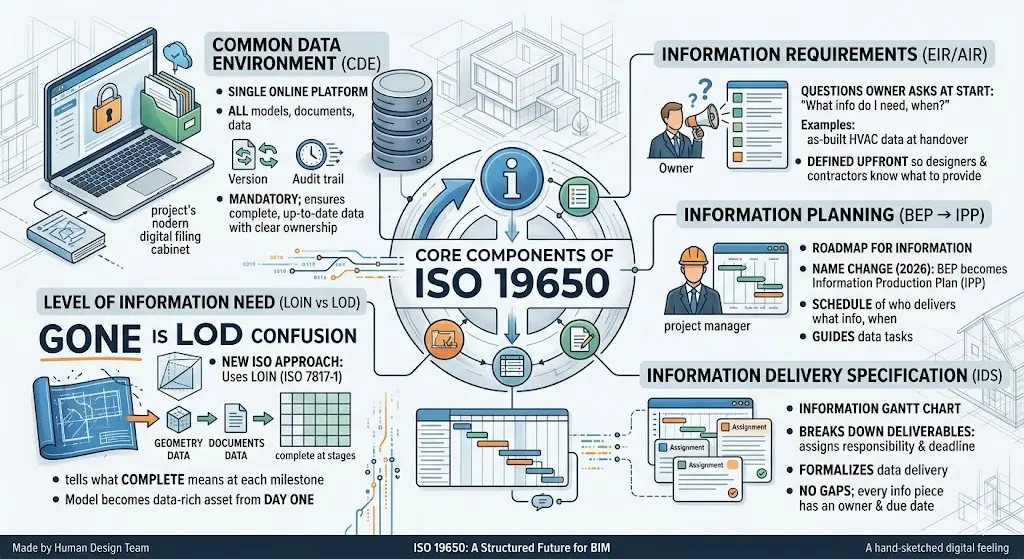
Take CDE as the project’s digital filing cabinet. It’s a single online platform where all models, documents, and data are placed. Instead of sending files via email, everyone checks in and out of the CDE. This gives version control and a clear audit trail.
Under ISO 19650, using a proper CDE is mandatory. Why? Because it proves your data is complete and up-to-date. You always know who added what, and nobody’s left wondering which file is the latest.
● Information Requirements (EIR/AIR)
These are the questions the owner asks at the beginning: “What info do I need from this project, and when?” In ISO terms, we call them Employer’s/Owner’s Information Requirements (EIR/AIR).
For example, an owner might list that they need an as-built BIM with all HVAC data by project handover. Defining these upfront means designers and contractors know exactly what to provide.
● Information Planning (BEP → IPP)
Every project needs a roadmap for information. That’s what the BIM Execution Plan (BEP) was—now renamed the Information Production Plan (IPP) in 2026. It’s a schedule of who delivers what info and when. The name changes, but it still guides your team’s data tasks throughout the project.
● Information Delivery Specification (IDS)
IDS works as an information Gantt chart since it breaks down each deliverable and assigns responsibility and a deadline. Under ISO 19650, the IDS formalizes who must deliver which pieces of data at each stage. This makes sure nothing falls through the cracks, and every piece of info has an owner and a due date.
● Level of Information Need (LOIN vs LOD)
Gone is the old LOD confusion. Remember how LOD 300 meant different things to different people. The new ISO approach uses Level of Information Need (LOIN) from ISO 7817-1. It’s a framework that defines the exact details, including geometry, data, and documents, needed for each object at each stage. In other words, LOIN tells us what complete means at each milestone. The model becomes a data-rich asset from day one.
Also read: BIM Level of Development (LOD): How to Choose the Right LOD 100–400 for Your Project?
How BIM Worked Before the 2026 Update
● Separation Between Delivery and Operations
Until the end of 2025, we treated design/construction and operations as two different worlds. The old ISO split them: Part 2 covered design/build, and Part 3 covered handover or operations. In reality, projects often used BIM only to coordinate design and generate drawings, then handed the model over to facility managers who got confused. The information flow stopped at handover.
● Limitations of BEP, LOD, and CDE
We did have good tools: a BEP (execution plan), levels of development (LOD), and a shared CDE. But these had limits. The BEP focused on construction deliverables, not post-occupancy data. LOD definitions varied by firm, so a Level 350 could mean different things. And the CDE usually stopped after handover; it rarely fed data into the Facility Management (FM) system.
● The Handover Gap Problem
The worst outcome was a useless handover. Teams delivered a perfect as-built model, but facility managers were left with confusing next steps. The model might have all the geometry, but missing serial numbers, warranty info and sensor data, which are the essentials needed for maintenance. This mismatch left assets underutilized.
Why Is ISO 19650 Being Updated?
Several pain points drove this change:
● Too Much Jargon
The 2018 standard often reads like lawyerspeak. Many teams found it a headache to analyze clauses. The draft aims to use simpler, plainer language so that engineers and managers can actually read it without a law dictionary.
● Duplication and Clutter
The old ISO sometimes repeated ideas across parts. The revision cuts redundancy. This means you will get one clear statement per rule, not paragraphs that note the same thing twice or more. Auditors and practitioners alike will appreciate having fewer cross-references.
● Beyond Just Building
BIM usage has exploded beyond design. Now it ties into digital twins, sustainability, smart cities, etc. The old standard didn’t emphasize those areas. However, the new draft reflects the reality that BIM models are part of ongoing building performance analysis, including energy, maintenance, and occupancy; hence, it structures requirements accordingly.
● Global Consistency
The construction industry is global. Countries are mandating ISO-aligned BIM (UK, US, EU, Singapore, UAE). But if each country interprets LOD or Information Manager differently, confusion follows. The 2026 update locks down definitions using universal ISO terms, like LOIN, IPS, etc. This consistency smooths out multinational projects and avoids endless debates about terminology.
What Has Changed in 2026 (Draft Proposals)
4 points are focussed by ISO 19650.
1. One Continuous Lifecycle Process
The draft ISO 19650 removes the old handover wall. Instead of separate workflows for construction and operations, it’s now a single unified process from day one through operation.
That means when you start the project, you plan not just for turning over a model, but for turning over a living data resource. The project’s Information Model literally becomes the Asset Information Model (AIM) post-handover.
Asset managers and owners set data requirements up front, and design teams deliver them along the way. The draft even suggests merging EIR and AIR: the owner says all required info at the beginning, and the team provides it as part of normal workflow.
2. From BIM to Information Management
You’ll notice the term BIM is getting removed in the text. Instead, the draft uses phrases like Information Management and Data Governance. Why? Because BIM had become overloaded, nobody was sure if it meant the model, the process, or the software. The update aims to clear that up.
ISO 19650 is about organizing and sharing data, regardless of which tools create it. In other words, BIM is the mode, but Information Management is the message. It’s as if BIM got a name change to emphasize that it’s the data that matters, not just the 3D shapes.
3. BEP Becomes the Information Production Plan (IPP)
One big terminology change: the BIM Execution Plan (BEP) is now called the Information Production Plan (IPP). The content is the same, which is your project’s roadmap for information tasks. But the new name highlights that planning info delivery is a core project responsibility.
After the new update implementation, you’ll replace BEP with IPP in contracts and templates, and take the chance to rethink your plan. Additionally, the new standard merges old sub-plans, like the MIDP/TIDP, into one Information Production Strategy (IPS) for simplicity. This means fewer separate docs and one unified plan.
4. Consolidation of Documentation (IPS, TIDP, MIDP)
Yes, more abbreviations changed: the old Task and Model Information Delivery Plans (TIDP/MIDP) merged into a single Information Production Strategy (IPS). Instead of dealing with multiple spreadsheets for task deadlines, you have one comprehensive plan now. This will simplify project paperwork while answering the same questions: who does what, and when. But now it’s brought in one place.
Key Terminology Changes in ISO 19650 (2026)
| Old Name | New Name | Focus Point |
| BEP | IPP (Information Production Plan) | Information delivery |
| LOD | LOIN (Level of Information Need) | Clearer framework |
| BIM | IM (Information Management) | Focus on data, not just models. |
| TIDP/MIDP | IPS (Information Production Strategy) | Old delivery sub-plans merge into one IPS |
| OIR/AIR/PIR | IPR (Information/Product Requirements) | (Draft hints owners may define combined requirements upfront |
What These Changes Mean for the Industry
● From BIM to Data Strategy
The biggest change is how we think about projects. The question we start asking is no longer “Are we doing BIM?” but “Are we managing information strategically across the asset lifecycle?” On day one of a project, we now ask owners:
- What performance data do you need?
- Who will use this data in 5 years?
This data-first mindset means planning with facility outcomes in mind. Our project’s initial meetings will sound different. Instead of sketching views, we might be listing sensor data or sustainability metrics on the whiteboard. Essentially, collaboration goals shift from software x or y to data completeness for operations.
● Increased Role of Asset Owners
Owners and FM teams become active players during design and construction. The new ISO expects them to define detailed information requirements from the start. This means designers and contractors coordinate with owners continuously.
The result is fewer end-of-project surprises as facility managers know earlier what they’ll get, and project teams avoid rework. For example, if the owner wants daily energy data after occupancy, that requirement drives HVAC sensor selection from day one.
● Greater Focus on Operations and Facility Management
Under ISO 19650:2026, a project isn’t successful until the building works well over time. Post-handover performance becomes a key metric. The draft explicitly broadens success criteria to include building operations and maintenance.
This means teams deliver models packed with operational info. You might even run integration tests to ensure your BIM feeds correctly into the client’s CMMS/FM system. The traditional turnover meeting becomes a joint workshop where operational staff see exactly how the BIM will support their work.
Industry Shifts Supporting the 2026 Update
● Smarter BIM Tools and AI Integration
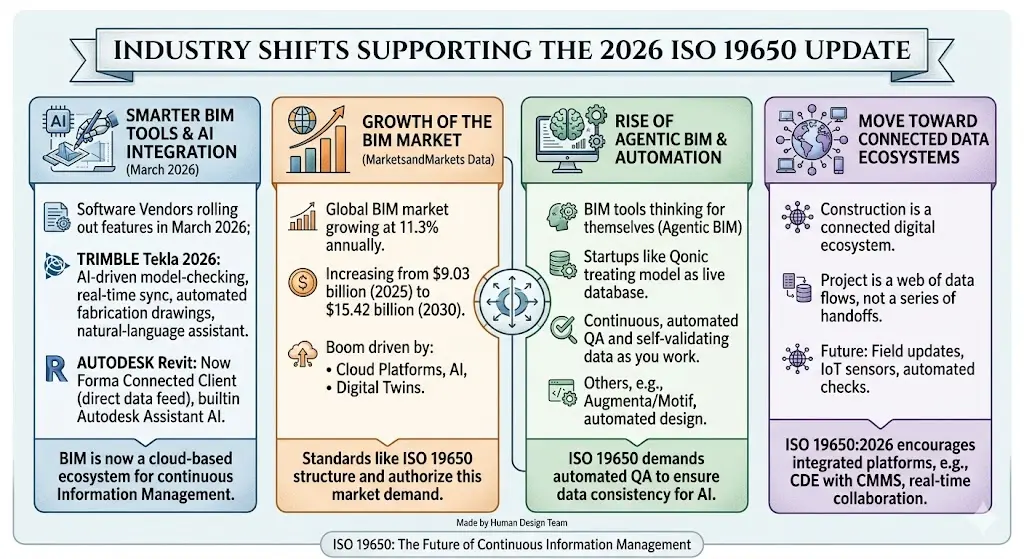
Just in March 2026, major software vendors rolled out features that align perfectly with this new ISO thinking.
- Trimble’s Tekla 2026, released March 11, added AI-driven model-checking and real-time model-to-drawing sync. For example, its new AI Cloud service can auto-generate fabrication drawings, and models now have live status updates and even a natural-language assistant. This means errors get caught early, and project data stays consistent across teams. It’s exactly the kind of connected, single source of truth workflow that ISO 19650’s update envisions.
- Autodesk did its part, too. Revit is now a Forma Connected Client (Tech Preview released March 2026). This means Revit can directly feed data into a cloud platform (Forma) and back, without messy file exports. Design iterations and environmental analyses carry straight through from Forma to Revit. Also, Autodesk Assistant (an AI chatbot) is now built into Revit, giving guidance in context.
These moves show that BIM is increasingly part of a continuous, cloud-based ecosystem, reflecting the ISO shift towards Information Management.
● Growth of the BIM Market
The industry is putting its money where it’s required. According to MarketsandMarkets, the global BIM market is growing at 11.3% annually, from about $9.03 billion in 2025 to $15.42 billion by 2030. That boom is driven by cloud platforms, AI, and digital twins, which are exactly the technologies ISO 19650 forces. In other words, the market demand for smarter, data-rich construction is increasing, and standards are catching up to authorize and structure that trend.
● Rise of Agentic BIM and Automation
Agentic BIM is a new phrase that describes BIM tools that think for themselves. Startups like Qonic are leading the charge. Qonic treats a BIM model as a live database; it continuously self-validates data against rules and standards.
Instead of the old cycle, model, check, and fix, Qonic’s BIM gets checked automatically as you work, highlighting inconsistencies and missing data in real time. That means your model could auto-notify you of a clash or a missing warranty number before the review meeting.
Others, like Augmenta and Motif, are pushing automated design further, but the common threads are intelligent QA and data automation. The rise of these tools underscores ISO 19650’s point: the future of BIM is continuous information management.
If software can catch errors and fill in data on the fly, we need a clear standard to ensure all that automated info feeds into operations correctly. The new ISO mindset doesn’t just permit agentic BIM, it practically demands it because inconsistent data will block these AI tools.
● The Move Toward Connected Data Ecosystems
Collectively, these trends point to one thing: construction is becoming a connected digital ecosystem. Models, drawings, RFIs, sensors, and cloud analytics are all connected to each other. The 2026 ISO changes essentially double down on this: a project is no longer a series of handoffs, but a web of data flows.
Going forward, you can expect field workers with tablets updating models live, IoT sensors feeding as-built data back to the BIM, and automated checks ensuring the right info lands in the right hands. ISO 19650:2026 is embracing this ecosystem by encouraging integrated platforms, like a CDE that aligns with CMMS, real-time collaboration, and end-to-end data visibility. If your firm isn’t already moving in that direction, the new standard will push you to catch up.
Who Should Follow ISO 19650?
- Owners/Clients: You need clear deliverables, and ISO 19650 helps you specify the data you expect from the project team.
- Architects & Engineers: You’ll coordinate design intent with operational needs. The updated standard makes sure your models carry lifecycle info for facility managers.
- Contractors & Subcontractors: You create the data that drives construction and operations, and ISO 19650 guides how to organize, hand off, and update information so nothing gets lost.
- Facility/Operations Managers: Ultimately, you own the building’s performance. The new ISO standards put you in the loop from the start, ensuring you get the data you need to run and maintain the asset efficiently.
Whether you’re a BIM manager, estimator, or structural engineer, ISO 19650 affects your job. It’s the rulebook for how information flows, no matter which hat you wear in construction.
ISO 19650 in the US: Trends Towards Adoption
North America has been an early adopter of digital construction, and it’s no exception with ISO 19650. Many U.S. government agencies and organizations encourage or require BIM workflows aligned with ISO standards.
For example, the U.S. National BIM Program has a roadmap that highlights aligning with ISO 19650 to ensure consistency in public projects. The research firm MarketsandMarkets even notes North America leading the BIM market thanks to strong governmental pushes for digital twins and smart infrastructure.
In the U.S., unlike some places, ISO 19650 isn’t technically law yet, but it’s fast becoming the industry expectation. Big firms and public owners alike are using it as their guide. The 2026 updates will likely accelerate US adoption.
So if you want to win public contracts or stay ahead in design-build, your processes will need to align. And since major US BIM software vendors, including Autodesk, Trimble, and Bentley, are now building their tools around these new concepts, it’s a good bet that ISO 19650:2026 will become the top standard here soon.
Benefits of ISO 19650 Compliance
● Better Collaboration
When everyone uses the same data rules and CDE, teams speak the same language. This leads to fewer misunderstandings and smoother coordination.
● Reduced Rework
Clear info requirements and continuous QA mean problems are caught early, not at handover. This ensures no more scrambling to fill missing data after the fact.
● Improved Asset Performance
Operations teams get the right data at the right time, leading to more efficient maintenance and management. The building runs better when the model is built better.
● Stronger Data Governance
With defined roles and processes, like the Information Manager role, your projects will have formal accountability for info quality. This means audits, compliance checks, and reporting become more streamlined.
● Competitive Edge
Early adopters of the new standard will stand out to forward-thinking clients. It shows you can deliver whole-life value, not just construction.
Challenges in Adopting ISO 19650
● Learning New Terminology
All those new terms, including IPP, LOIN, IPS, and IPR, mean a learning need. Everyone from project managers to field supervisors will need training on the updated language. Teams might confuse BEP and IPP at first, or treat LOIN like the old LOD.
What you need to do is to plan for workshops or cheat-sheets so that when the update arrives, your staff isn’t googling definitions in meetings.
● Updating Contracts and Documentation
Since terms are changing, your existing paperwork needs an update. Every contract, EIR template, BIM guideline, or specifications sheet that notes LOD or BEP will need editing.
This is a challenging task, but the key is to do it systematically. Update templates early and flag older documents to avoid confusion about which version to follow during the transition.
● Adjusting Roles and Workflows
The new standard formalizes some roles and processes. You may need to shuffle responsibilities. Perhaps an operations engineer will now join design meetings, or the BIM manager will oversee the AIM’s lifecycle. Also, workflows will change; maybe you will need to add a step to check COBie data at stage milestones.
Make up your mind for some resistance because humans naturally don’t like change. You can mitigate this issue with effective communication. Explain why these roles exist and how they help the team avoid late-stage headaches. In addition, some initial productivity drop is normal, but you should frame it as a short-term issue for smoother projects later.
● Upgrading Legacy Systems
If your current CDE is just a network drive and your field reports are on paper, get ready to modernize. The draft effectively requires integrated tech. So assess your tools now. You might move to a real cloud CDE or invest in a digital twin platform.
Ensure your BIM software can export the needed data and connect with FM systems. These upgrades cost time and money, but they’re part of compliance.
● Managing Short-Term Disruption
Big changes always have bumps. For a while, your teams might be unsure whether to use BEP or IPP, or old forms vs new ones. Some tasks might overlap awkwardly.
To handle this, create a clear transition plan. You can run a pilot on a new project using the draft terms, while phasing out old templates on current jobs. Keep both sets of documents side-by-side until everyone is confident.
How to Prepare for ISO 19650 Changes?
● Assess Your Current BIM Maturity
First, benchmark where you stand today. Conduct an ISO 19650 compliance audit or use a BIM maturity model. Ask yourself:
- Do we use a fully-functional CDE with version control, or just email attachments?
- Do we have clear EIRs/AIRs, or vague owner wish lists?
- Are roles (BIM Manager, Info Manager) defined, or do people double up on tasks?
- Is our data standardized (COBie templates, classification schemas) or all over the place?
Identify gaps. If your BIM is already top-notch, you can save effort by focusing only on missing areas. If not, this audit tells you where to start.
● Refine Your Information Requirements
Now is a great time to revisit those EIR/AIR documents. Make sure each requirement is crystal clear. For example, don’t just say MEP Model; specify MEP model, including equipment room layouts, panel schedules, and submittal docs. For every requirement, ask why, what format, and by when.
If anything sounds off, clarify it on time. Also, consider drafting or tightening your IDS (Information Delivery Specification). The IDS lays out exactly who delivers what and when for each requirement. Having a detailed IDS means everyone knows their piece of the puzzle.
● Invest in Training and Education
Don’t wait until 2027. Begin training now so your team understands why these changes matter. Run in-house workshops or hire a consultant to walk through ISO 19650:2026 concepts. Make sure everyone from your BIM leads to field supervisors gets the high-level picture.
Furthermore, teach the team how LOIN works or practice filling out an IPP. The more comfortable your team is with the concepts, the faster they’ll adapt. Also, if you’re switching software, give people time to learn it well before the deadline.
● Upgrade Your Technology Stack
This is the year to test your tech. Check if your tools can handle the new workflows by answering these questions:
- Does your BIM platform integrate with cloud CDEs?
- Can your FM software import data from COBie/ifc?
If the answer is no or not easily, start budgeting for upgrades. You might move models to a cloud service, adopt a new CDE, or get a plug-in that connects BIM to your CMMS.
Ensure everyone’s on compatible versions, network security is solid, and data formats are standardized. Aligning your tech infrastructure now will make compliance perfect later.
ISO 19650 Compliance Checklist (2026)
- Implement a Real CDE: Use a cloud-based common data environment with version control and access logs.
- Define Clear Information Requirements: Refine EIR/AIR, make them specific and outcome-oriented.
- Develop an Information Production Plan (IPP): Schedule who produces which data and when.
- Adopt Level of Information Need (LOIN): Specify the detail required for each object and stage.
- Ensure Lifecycle Data Flow: Plan for data to carry through design, construction, and operations.
- Use Standardized Formats: Utilize IFC, COBie, or other open formats for data exchange.
- Train Your Team: Educate staff on new terms and workflows before the standard takes effect.
- Upgrade Tech: Ensure your software supports integrated, real-time collaboration (cloud BIM tools, IoT, APIs).
Regularly check this list as you go since it covers the core steps to get ready for ISO 19650:2026.
FAQs
● Who needs to follow ISO 19650?
Anyone working on a BIM project should at least understand ISO 19650 principles. That includes owners/clients, architects, engineers, contractors, subcontractors, and facility managers.
Why is ISO dropping the term BIM?
Because BIM has become a confusing term now, the updated standard emphasizes information management across the whole project life. It’s not about any one software or model; however, it’s about structuring and governing data from design through operations.
What are the key changes in 2026?
Major changes include merging design and operations into a single process and updating terminology. For example, the BEP is now the IPP, EIR/AIR becomes a unified requirement set, and a new 9-step information management workflow replaces the old split phases. The standard also swaps LOD for LOIN and ties in ISO 7817-1 and ISO 29481-1 for clarity.
● When will the new version take effect?
Draft revisions (Draft International Standard) were released for consultation on March 10, 2026. After public feedback and committee approvals, the final ISO 19650 updates are expected by 2027. Until then, the 2018 standards remain in force. This transition period lets teams prepare and align with the draft changes before they become mandatory.
● Has BEP disappeared?
Not really, it’s just been renamed. The BIM Execution Plan (BEP) becomes the Information Production Plan (IPP). Its purpose is unchanged as it’s still the document describing how your team produces and delivers project information. You’ll simply update your templates and call it IPP now, but your workflow of scheduling data tasks stays the same.
Let’s connect and ensure your next project doesn’t just pass inspection, but powers efficient operations for years to come!
Conclusion
ISO 19650:2026 is about treating your building as data from day one. The core message is: plan with the whole lifecycle in mind. Start projects by asking what information we need after handover, rather than just what drawings we deliver. This means setting clear data requirements early, using IPPs and LOIN, and upgrading to collaborative tools now. Doing this will pay off in better coordination, reduced surprises, and a building that performs better.
So update your docs and training. Most importantly, focus on your data needs across the project lifecycle. Remember that implementing these changes can seem challenging, but that’s exactly where CAD Drafters come in. We know how to make ISO compliance practical. From CDE setup to IPP templates and training workshops, our services streamline your workflow. We’ve helped contractors, architects, and owners everywhere move to the data-driven side of construction.