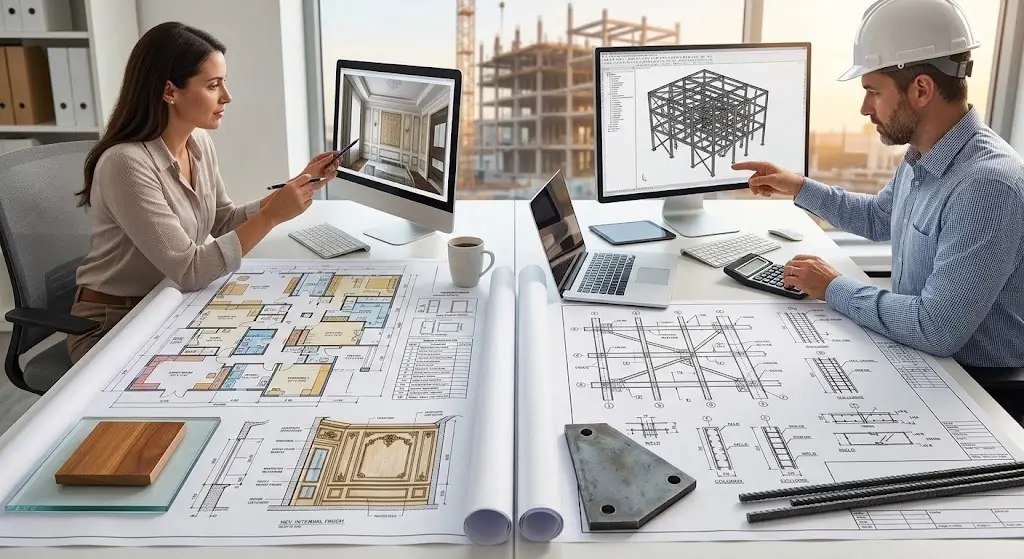
Suppose you are bidding while feeling low about designs. On paper, drawings are fine, but your mind is popping up with many questions related to loads, sequence, and on-site specifics. You can turn this uncertainty into workable plans with structural engineering. It is the way that bridges the gap between design and actual construction. You can have accurate takeoffs and estimates when you support your plans with structural engineering.
Continue reading to get everything you must know about structural engineering!
What is Structural Engineering?
As a contractor or a builder, you must know that it is a sub-branch of civil engineering that focuses on the following aspects of construction projects:
- Designing
- Analyzing
- Construction
The Purpose of Structural Engineering
By applying physics and mathematics, this ensures structures can withstand harsh conditions, like wind, storms, earthquakes, etc. Let’s see how this type of engineering helps contractors achieve building goals.
Types of Structural Engineering
You’ve probably worked with structural engineers on a job site and thought, “Do I really need to know all this?” In my point of view, yes. Understanding the roles of each type of structural engineering helps contractors save time and money by making the right decision on time. So, let’s start!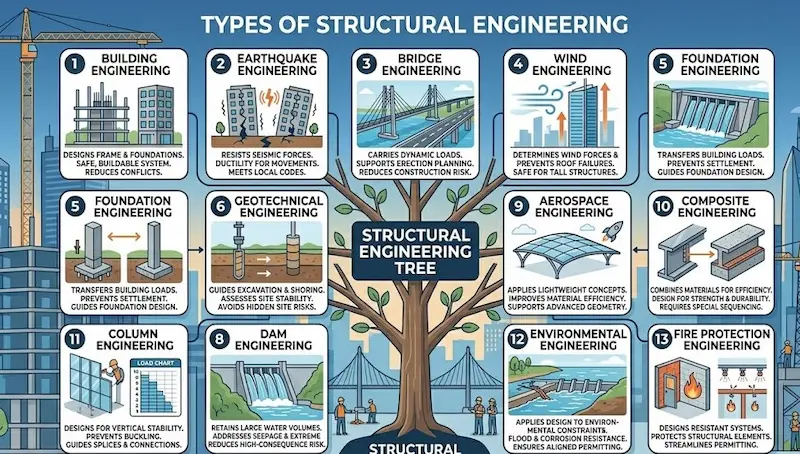
● Building Engineering
A building engineer’s role is to design the main structural frame for buildings, including beams, columns, slabs, walls, and foundations.
How Does It Help?
- Gives the contractor a safe and buildable structural system
- Coordinates the frame with architectural and MEP layouts
- Reduces field conflicts during construction
When You Must Use It?
Use building engineering for most vertical construction projects, such as apartments, offices, schools, hospitals, warehouses, and other enclosed buildings.
● Earthquake Engineering
An earthquake engineer is responsible for designing structures that resist seismic shaking and avoid collapse.
How Does It Help?
- Improves structural safety in seismic zones
- Provides detailing for ductility and controlled movement
- Helps meet local regulations and avoid redesigns
When You Must Use It?
Rely on earthquake engineering when your targeted building is in seismic regions, plus when local codes require seismic design, detailing, or analysis.
● Bridge Engineering
As the name shows, under the cap of bridge engineering, experts design bridge structures that carry traffic across roads, rivers, railways, or other obstacles.
How Does It Help?
- Addresses heavy dynamic loads and fatigue
- Supports staging, falsework, and erection planning
- Reduces risk during complex bridge construction
When You Must Use It?
Use bridge engineering for any bridge, elevated crossing, or long-span transport structure.
● Wind Engineering
Wind engineering is the discipline in which professionals study how wind affects buildings and structural components.
How Does It Help?
- Determines uplift, anchor, and fastening requirements
- Helps prevent roof and facade failures
- Improves safety for tall and lightweight structures
When You Must Use It?
Contractors rely on wind engineering for tall buildings, open structures, canopies, roofs, and projects that are in high-wind areas.
● Foundation Engineering
It’s all about building load transfer. A foundation engineer designs the system that transfers building loads into the ground.
How Does It Help?
- Prevents settlement and foundation failure
- Helps choose footings, mats, or piles
- Reduces expensive rework below grade
When You Must Use It?
Foundation engineering is applied whenever a construction project needs structural support below grade. It becomes highly essential for large or heavy buildings.
● Geotechnical Engineering
Geo means related to the earth. This discipline explores soil, rock, and groundwater conditions at the construction site.
How Does It Help?
- Shows whether the site can support the structure
- Guides excavation, shoring, and foundation design
- Helps avoid hidden site risks
When You Must Use It?
Geotechnical engineering is always applied before foundation design, excavation, or working on any construction project that has uncertain soil conditions.
● Facade Engineering
As the name suggests, a facade engineer designs the building envelope. They include cladding, glazing, curtain walls, and exterior attachments in the designs.
How Does It Help?
- Prevents water intrusion and panel failure
- Improves coordination between structure and exterior systems
- Helps meet tolerance and movement requirements
When You Must Use It?
You must rely on facade engineers for curtain walls, glass systems, cladding, and any construction project that has complex exterior coverings.
● Dam Engineering
A dam engineering team designs structures that retain, control, or redirect large volumes of water, which is mostly used for electricity production.
How Does It Help?
- Addresses extreme pressure and seepage conditions
- Requires detailed QA/QC and inspection planning
- Reduces risk in high-consequence water-retaining work
When You Must Use It?
You need to use dam engineering when targeting dams, spillways, flood-control structures, and hydroelectric water-retaining systems.
● Aerospace Engineering
An aerospace engineer applies lightweight, high-efficiency structural concepts to specialized construction systems.
How Does It Help?
- Supports long-span and lightweight structures
- Improves material efficiency
- Helps with advanced geometry and performance-based design
When You Must Use It?
You must rely on aerospace engineers for specialty roofs, membranes, canopies, and highly optimized long-span systems.
● Composite Engineering
Under this discipline, engineers design systems that combine materials to improve the strength, efficiency, or durability of a construction project.
How Does It Help?
- Reduces material use in some assemblies
- Improves structural efficiency
- Requires special sequencing and connection details
When You Must Use It?
You can rely on composite engineers when your construction project includes steel-concrete composites, FRP, engineered timber, or other hybrid systems.
● Column Engineering
A column engineer focuses on the design and stability of vertical load-bearing members.
How Does It Help?
- Prevents buckling and instability
- Guides splice, bracing, and connection work
- Helps manage heavy load transfer in tall structures
When Your Contractor Must Use It?
Use column engineering whenever columns carry major vertical loads, especially in multi-story buildings and heavily loaded frames.
● Environmental Engineering
An environmental engineer applies structural design to sites with environmental constraints or exposure risks.
How Does It Help?
- Supports work in flood-sensitive, coastal, or contaminated regions
- Brings corrosion resistance and improves durability
- Ensures designs and permit requirements are aligned
When You Must Use It
Experts rely on environmental engineers for waterfront work, flood-resistant construction, shoreline projects, wetlands, and contaminated sites.
● Fire Protection Engineering
A fire protection engineer designs systems that help a building structure resist fire and maintain life safety.
How Does It Help?
- Supports code compliance
- Protects structural elements during fire exposure
- Reduces inspection issues and streamlines permitting
When You Must Use It?
Fire protection engineering is the right option whenever your targeted project requires rated assemblies, fireproofing, firestopping, or structural fire resistance.
How Structural Engineering Powers Construction Success
Structural engineering comes with many aspects that you must understand and handle professionally to see clear results in the form of reliable outcomes.
● Sequencing
For you, sequencing might be just a schedule box; however, it is more than that. It decides:
- What gets loaded
- What gets braced
- And what gets built first
When your orders are right, your team works faster and wastes less time waiting for materials. This further supports a contractor to keep everything flawless on site while ensuring the best structural integrity.
● Temporary Structures
Temporary means:
- Shoring
- Formwork
- Scaffolding
- Bracing
All these should be done right the first time. By doing so, you can ensure the right sizing of structures as well as check how they interact with the permanent ones. This way, you can keep the project budget on point from designing to actual construction.
● Safety Standards
Safety does not only mean when inhabitants start living in the building. However, it starts when the construction teams arrive at the site to begin their job. And the surprising point is that you can identify the safety risk before reaching the site. How? Thanks to the structural engineering safety assessment.
This is something that helps the team identify:
- Risky load transfers
- Weak points during erection
- Conditions that can change with weather or staging (temporary supporting structure).
When a team identifies these risks early, the construction site becomes easier to control, and the laborers get a safer place to work.
● Design and Planning Expertise
As a contractor, you understand that sound planning keeps a construction project from shaking from start to end. With structural engineering, you can have a clear read on load paths, member behavior, and connection intent.
Using this data, you can identify issues, ask questions about drawings, confirm assumptions, and avoid field guesses. Ultimately, this leads to accurate cost estimation and efficient project execution.
● Cost & Time Management
In construction, cost and time move together. Both get affected when even a single point is changed in the plan. It is where structural engineering helps. Using it, you can make choices that are easy to build and deliver, with almost >5% chances of rework. Simply put, you can run your project while ensuring fewer RFIs, streamlined procurement, and competitive bidding.
● Risk Control
You already know that all construction projects, including small and big ones, carry some risk. With effective strategies, you can stop the maximum number of them from turning into problems. How? Structural engineering, as it helps identify the weak points during the design phase.
Including weather exposure, overloads, and field changes, you can identify and control all before letting them reach the construction site. This straight reduces the rework and ensures on-time delivery of the project.
● Quality Control
It is something that starts with building standards and clear client expectations. Professional contractors and builders rely on structural engineering for the best quality control. Your inspectors and field managers can have a solid basis for comparing the work against design intent. Thus, misalignments, missed embeds, and other small errors are caught before they expose in the form of repairing cost.
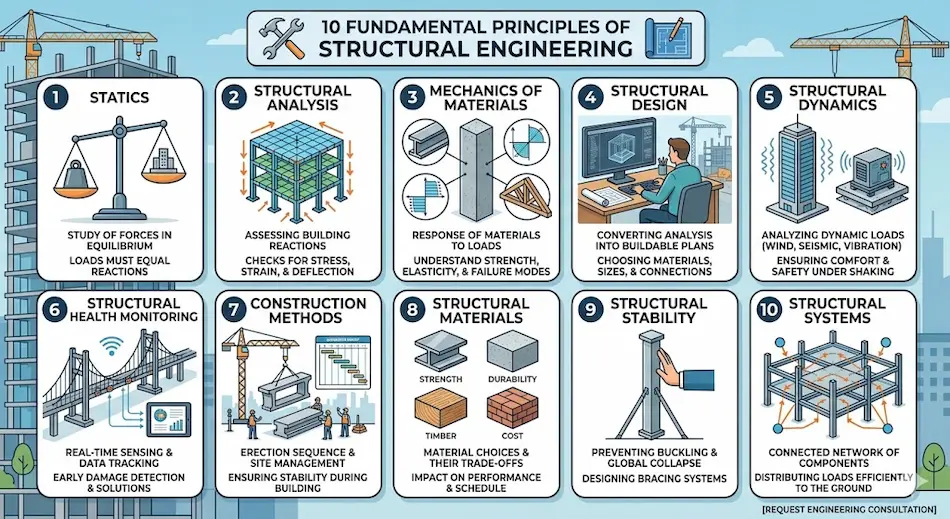
What Are the Fundamental Principles of Structural Engineering?
The discipline runs on a core set of principles that every engineer and every contractor should understand. Let’s go through each one.
1. Statics
Statics are where everything starts. It’s the study of forces acting on structures that are at rest, meaning not moving, not accelerating. Engineers use static analysis to ensure every load applied to a structure has an equal and opposite reaction somewhere in the system.
You can take it as the balance sheet of structural engineering. Every force has to go somewhere. Gravity loads, lateral pressure and wind all find their path through a statically designed system. If the statistics aren’t sound, nothing else in the structural steel holds up.
2. Structural Analysis
Structural analysis checks how a building reacts to dead loads, live loads, wind, seismic effects, and equipment forces. It shows whether members deflect too much, crack early, or overstress under realistic conditions.
For contractors, this is where design intent meets actual jobsite behavior. You see the difference in beam sizes, connection demands, temporary bracing, and sequencing. Good analysis does not just prove a structure can stand. However, it proves the structure can perform without becoming a maintenance headache later.
3. Mechanics of Materials
Once you know the forces, you need to know how materials respond to them. Mechanics of materials covers stress, strain, elasticity, and failure modes for steel, concrete, timber, and other structural materials.
Engineers assess everything, including:
- Whether a beam will yield under bending
- Whether a column will buckle under compression
- Or whether a connection will fracture under tension
Note that substituting materials without engineering review can trigger project failures. Therefore, informed decisions are essential here.
4. Structural Design
Structural design turns analysis into something buildable. It chooses member sizes, materials, connections, and construction methods that satisfy safety, function, code, and budget. For US contractors, this matters because a design that looks good on paper still has to fit the field.
Good structural design reduces rework, keeps inspections cleaner, and avoids details nobody can actually install. It also considers the real sequence of construction, which is where many problems begin.
5. Structural Dynamics
Many contractors believe that structural dynamics is all about just steady loads. However, it also considers changing loads. In addition to gravity, earthquakes, wind gusts, machine vibration, and impact loads can shake a structure. That matters in tall buildings, industrial platforms, and any project with moving equipment.
Contractors should care about this principle because vibration often shows up as complaints long before visible damage appears. Remember that a structure can be strong and still feel wrong. Dynamics helps prevent that uneasy, shaky behavior that makes repairs expensive.
6. Structural Health Monitoring
It is something that uses sensors and data to track how a building structure behaves over time. This means you can identify damage early and implement solutions before loss. On major projects, that can mean strain gauges, movement sensors, crack monitoring, or regular data review.
For contractors, this is useful on critical facilities, aging assets, and retrofit work where the structure already carries a story. Monitoring gives owners evidence, not guesses. And in the field, evidence cuts arguments.
7. Construction Methods
Construction methods cover the actual sequence, equipment, and means used to build the structure safely. This principle matters because a design can be stable in the final state but fail during erection. Temporary bracing, lift order, connection timing, and partial-load conditions all matter.
Good engineering considers the build sequence from the start. That cuts down on field improvisation, which is usually where the expensive surprises hide.
8. Structural Materials
Structural materials shape the whole project. Steel, concrete, timber, masonry, and composites each bring strengths, weaknesses, and cost tradeoffs. Contractors live with those choices every day, because material behavior affects handling, connections, fire resistance, durability, and schedule.
Steel moves fast, concrete brings mass, timber offers efficiency, and composites solve special problems. The right material depends on load, exposure, budget, and detail quality. If you choose wrong, the structure starts opposing the project from day one.
9. Structural Stability
A structure can carry its design loads but fail if it’s not stable. Stability engineering addresses buckling of slender compression members, lateral-torsional buckling of beams, and global overturning of frames under lateral loads.
Engineers design bracing systems, moment-resisting frames, and shear walls specifically to ensure stability under all load combinations. For contractors, considering temporary bracing requirements during erection is part of this. Note that removing bracing too early before connections are made, is one of the leading causes of collapse during construction.
10. Structural Systems
Structural systems are the connected network of beams, columns, slabs, trusses, and frames that move loads to the ground. Good systems do more than hold weight. They distribute it, share it, and create redundancy when one part gets stressed.
For contractors, system understanding helps with sequencing, coordination, and clash avoidance. It also makes field changes less dangerous, because you see how one move affects the whole frame. A structure works best when every piece knows its role.
The Future of Structural Engineering
In 2026, structural engineering is all about being smarter and greener. Instead of doing math by hand, engineers now use AI software that automatically checks building rules and picks the best materials in seconds. This allows engineers to focus on big-picture planning rather than just playing with numbers.
They are also using eco-friendly materials like mass timber to protect the planet while keeping costs down. At the same time, smart buildings now use sensors to tell us when they need a repair before anything actually breaks. In short, the modern engineer is less of a calculator and more of a strategist.
Software Used in Structural Engineering
Structural engineering has transformed dramatically over the past few decades. Gone are the days when engineers relied solely on manual calculations, slide rules, and endless spreadsheets. Today, powerful digital tools drive nearly every stage of design, analysis, and construction. These tools not only improve accuracy but also save time and reduce costly design errors.
Why Software is Essential in Modern Engineering
Imagine trying to design a 50-story skyscraper using only pen and paper. Sounds impossible, right? That’s exactly why software is indispensable today. Structural engineering software allows engineers to calculate complex load distributions, simulate environmental forces, and optimize materials efficiently.
These tools eliminate guesswork. Instead of manually computing every stress point, engineers can run simulations that model real-world behavior with extreme accuracy. This not only ensures safety but also reduces material waste, making construction more sustainable.
Another major advantage is collaboration. Multiple engineers can work on the same digital model in real time, updating changes instantly. This is especially important for large infrastructure projects where architecture, mechanical systems, and structural systems must align perfectly.
Categories of Structural Engineering Software
Structural engineering software is not a single category; it is a combination of multiple specialized tools working together.
● Structural Analysis Software
These tools focus on calculating how structures behave under different loads. Examples include ETABS, SAP2000, and STAAD.Pro. They are used for seismic analysis, wind load calculations, and structural optimization.
● BIM (Building Information Modeling) Software
BIM tools like Autodesk Revit and Tekla Structures create intelligent 3D models of buildings. These models contain data about materials, geometry, and construction phases.
Note: Understand what BIM is in detail!
● Drafting and CAD Tools
AutoCAD remains a fundamental tool for creating 2D drawings and technical blueprints. Despite advancements in BIM, CAD is still widely used in documentation and detailing.
● Specialized Design Software
Advanced tools like ANSYS and Abaqus are used for high-level simulations such as nonlinear stress analysis, thermal effects, and material deformation.
Optimize your workflow by combining the right structural analysis, BIM, and CAD software. Speak with our experts to design a streamlined engineering stack for your next project
FAQs
What is the difference between a structural engineer and a civil engineer?
A civil engineer works across broader sites, infrastructure, and project systems, and the engineer goes deeper into how the building stands. Both work together for long, durable performance of the building.
How does CAD drafting help structural engineers?
CAD drafting turns calculations and design intent into clear drawings, details, and plans. It speeds revisions, reduces confusion, and helps contractors understand exactly what to build. That makes coordination smoother across the whole project team. That usually shows up later as fewer revisions and cleaner coordination.
Why is structural engineering important in construction?
It keeps buildings safe, stable, and buildable. It also supports better sequencing, fewer errors, stronger cost control, and clearer coordination. Contractors rely on it when they need accuracy, accountability, and fewer surprises in the field. That usually shows up later as fewer revisions and cleaner coordination.
Conclusion
Structural engineering is what turns a set of drawings into a safe, buildable, and cost-effective project. From load paths and sequencing to temporary support, quality control, and long-term durability, it gives contractors the clarity they need to bid smarter, reduce rework, and keep jobs moving smoothly in the field. When structural details are planned and documented properly, construction teams can work with greater confidence and fewer costly surprises.
At CAD Drafters, we help support structural engineering projects across the US with accurate CAD drafting services that make complex designs easier to coordinate, review, and build. Whether you are working on a new structure, a retrofit, or a specialty project, our drafting support helps bring precision to every stage of the process. If you need dependable structural drafting support that aligns with real-world construction demands, CAD Drafters is ready to help.
Related Guides:
- The Ultimate Guide To Conceptual Design In Engineering & Drafting
- Step-by-Step Process of Structural Design: From Engineering Analysis to Construction Drawings