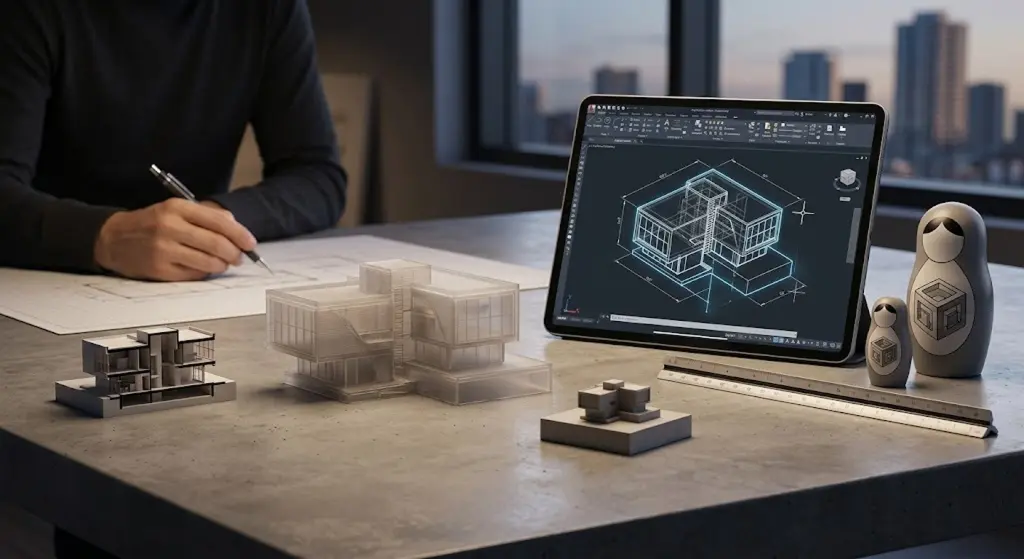
Homeowners are increasingly moving away from traditional on-site construction for their home expansion and building projects. This process is time-consuming, unpredictable, and difficult to manage for busy professionals managing multiple obligations. In 2026, homeowners are using prefab home addition solutions for their home expansion because they provide an accurate budget range required for the project before they even start working on it. Also, using Computer-Aided Design (CAD) designs, you’ll be able to see the outcome. It helps residential homeowners visualize the results first so that any alteration and modification required in the design can be done at the starting stage. It saves people from reconstruction and extra labor costs.
Prefab and modular room additions offer a combined solution for owners who look for precision and speed at the same time. They save owners from delays because of poor weather conditions and prevent the unexpected errors common in manual labor that lacks modern precision.
For homeowners interested in visualizing and planning precise home additions, explore our guide on 3D Architectural Rendering to see how CAD designs bring your project to life.
What Are Prefab Home Additions
A prefabricated home addition is a building extension that is manufactured by contractors off-site using advanced machinery and ensuring accuracy. The pre-constructed components are then transported to the desired location for final assembly.
Difference from Traditional Construction
This process is very different from the traditional construction that requires everything to be done onsite, such as flooring, wall construction, and the overall structure of the expansion. Whereas in prefab and modular construction, each component of the project is prepared off-site in the factory under controlled conditions and using the precise measurements taken by the professionals.
Design Flexibility and Customization
Flexibility in choosing the design, material, and quality is what makes prefab homes the preferred choice for residential homeowners. Unlike traditional construction projects, where owners have no room for choosing options or selecting modern designs, it’s now possible to achieve the desired outcome without worrying about labor errors.
Role of CAD Drawings in Prefab Construction
CAD drawings give accurate measurements for each detail of the project, which makes it highly efficient for prefab manufacturers to build the desired design or structure.
Prefabs can cover different dimensions, including multiple bedrooms, workspaces, and even a living area. They are customized according to the desires of the customer, their budget, and space availability.
Advancements in Prefab Construction (2026)
Modern technology has made room additions an easier and more reliable option than traditional construction by offering better quality, accuracy, customized features, and even better transportation, ensuring client satisfaction throughout the process. The advanced features of prefab and modular construction have encouraged homeowners to use the preconstructed projects and then get them assembled at the desired location.
Learn how CAD Drafting Specializations help prefab home additions achieve precision, customization, and efficient off-site construction.
Prefabricated Home Additions vs. Modular Additions
Although prefab and modular additions are similar, there is a distinct difference that needs to be understood before deciding on your project. Owners, when looking for contractors, must know the clear difference between these two processes and then make a decision depending on their preferred choice.
What Are Modular Home Additions?
Modular home additions are comprehensive and complete before they are transported to the location for assembly. They include the flooring, ceilings, walls, and even plumbing and electrical wiring fixed, and require minimal on-site labor to become habitable.
What Are Prefabricated Additions?
On the other hand, Prefabs are pre-constructed components and frames that are partially completed and need a bit more installation time than the modular additions.
Customization vs. Complete Construction
If you are looking for a completely constructed component, modular expansion is best, and if you prefer the flexibility of architect-designed and precise structure, then prefab is the best choice for such homeowners.
Suitability for Different Project Types
For complicated architectural buildings, prefab is considered to be more reliable because it provides more customization than modular additions. Modular units offer the complete project to be transported all at once to the location where expansion is needed. It can be an extra room on the ground floor or a complete first floor.
Factors to Consider When Choosing
Selecting between these two clearly depends on the requirements, budget, structural desires, and timeframe because modular takes no time to assemble, whereas prefabs require more customization. In 2026, both of these approaches are widely being used depending on multiple factors, but both of them serve their best services to the clients. With the help of modern technology and machinery, they have almost replaced traditional construction in this fast-moving world.
Explore the Step-by-Step Process of Structural Design to understand how prefab and modular additions are planned, customized, and built efficiently.
Why Homeowners Choose Modular Additions: Cost, Speed, and Precision
Prefab and modular additions offer significant benefits to their users that make them the most reliable option for the owners. One of the most advantageous aspects is that it takes less time to build than on-site construction projects.
Traditional construction requires everything to be aligned and constructed on-site. For that, the transportation of machinery, material, and other equipment to the building location makes the process slow. It even increases the chances of transportation damage to the machinery or the material itself. Whereas in the prefab and modular additions, this approach saves time because the complete project is completed in a professional setting where all the equipment and machinery are available to support the workforce and ensure efficiency.
Better Cost Control and Budget Management
Cost control is another factor that owners keep in mind while selecting between traditional and modern room additions. In traditional construction, there is always a possibility for material damage during the process or a change in the plan that requires more material and labor, resulting in delays. But in modern additions, every detail is preplanned, and it’s completed in a professional setting that ensures no material wastage and damage during the construction process.
There is no cost for the transportation of the material and machinery from the factory to the on-site location, which can result in significant cost savings. This gives owners financial freedom, as they are sure about the exact budget required and don’t have to worry about any hidden costs that might arise during traditional construction.
Consistent Quality and Precision
Quality of the work is also considered as a factor that one must consider during the selection process. Prefabs and modulars ensure the quality of the project because everything is handled and managed under the assistance of a professional and controlled setup, where every possible technical issue can be resolved immediately.
As almost completely constructed compartments and pre-manufactured room additions are transported to the location with simple assembly, it helps the residents to continue with their routine and doesn’t disrupt any of their daily tasks.
Discover how Design-Build approaches optimize prefab and modular additions for efficiency, cost control, and high-quality construction.
Design Tips for Prefab Home Additions
CAD drafting tools help in making accurate designs, and owners are able to see their thoughts in the form of a completed drawing even before starting the project. This helps them to be confident about their selected design and how it turns out after completion.
The design can only serve its purpose properly when the designers are well aware of the specific intent and functional requirements of the expansion. For example, when planning a modular addition of two rooms, designers won’t be able to draw efficiently unless they are aware of that room usage, whether it’s a kid’s room, a guest room, or a bedroom. Once it’s cleared, then designers can use and suggest the trending designs while aligning the consistency and appearance of the overall home.
Proper Site Measurement
This is the very first and the most crucial step of the overall expansion building process. It is to make sure that the measurements and calculations are done precisely during this step because these measurements act as a base for the further drawings and finally the construction process. If minor errors are made during measurement, they will eventually cause problems. A single incorrect calculation results in the entire expansion being manufactured based on those incorrect figures.
In order to avoid these mistakes, designers use modern technologies like CAD drafting software and laser scanners that automatically scan the dimensions, layout, and elevations in the structure with no room for error. Then these measurements are used by the CAD software to make the drawings that can fit on the page without changing the proportions, and allow the project to be completed in the given timeframe. Properly calculated measurements save owners from costly mistakes.
Integration with Existing Home
Designing the accurate expansion is not the only thing to keep in mind, but making it a part of the existing home is the real art. The success of any home addition project mainly depends on the design, which is how the design is aligned with the existing structure and how well it matches the aesthetics, efficiency, and provides convenience to its residents. A well-designed room addition doesn’t just give the matching aesthetics but also provides seamless contribution to the functionality and comfort.
Designers must consider the quality of the material used in the existing portion and design the new project accordingly. The expansion part must look like a part of the home and prevent a disjointed or mismatched appearance. Proper alignment and consistency make it possible.
Functional Layout Planning
A properly planned layout is essential when making designs for the expansion because the core responsibility of the designer is to use the space in the most effective way. They must consider all aspects that, if today the expansion is used for the workspace, it can also be used as a bedroom in the future.
Considering factors such as ventilation, spaces for moving from one place to another, and also taking care of sunlight exposure is also essential. Open designs are preferred because they make the space look bigger and are more accessible to the light and air.
Interior & Exterior Finishes
Modular additions ensure the interior finishes must be suitable for the client’s needs, like comfort and their atmospheric quality preference. In contrast, the exterior finishes, like walls, structure, and paints, must be done while keeping in mind that the modular or prefab addition to the existing home is also a part of the home, and it must look like a part of the home.
Taking care of interior and exterior design and structure can make the project a complete success. Ensuring comfort, along with the external alignment in respect of appearance and functionality, is considered a core part of the design.
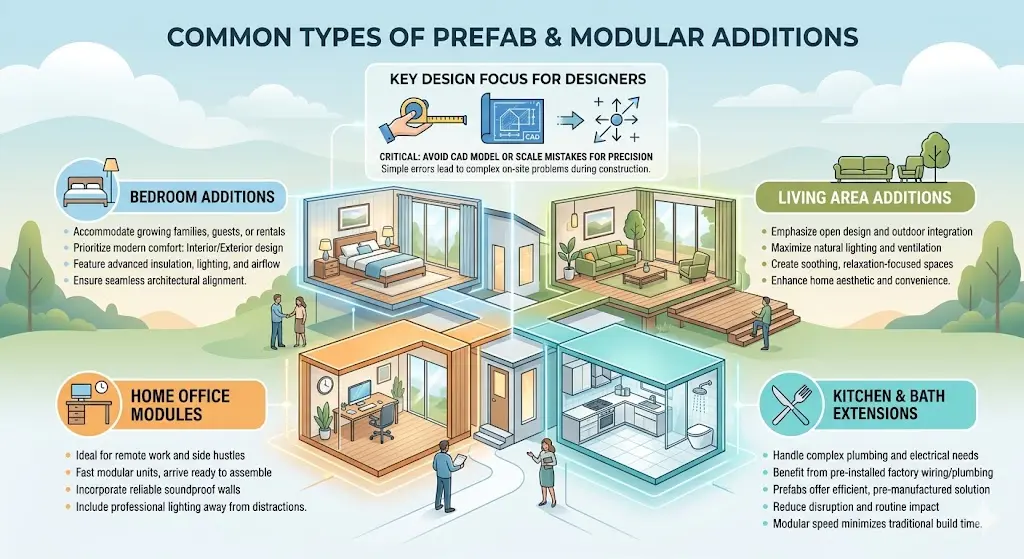
4 Most Popular Types of Prefab & Modular Additions
When designers use CAD for drawings and resizing the designs to get them printed on the page with accurate measurements, dimensions, and structural elevations, they often make mistakes in using models or while applying scale.
It’s too simple and doesn’t grab the designer’s attention at the start, but once construction works for modular and portable additions, it creates bigger problems.
Bedroom Additions
The most frequently requested addition by residential homeowners is the bedroom addition. The need for the prefab or modular room addition arises when the family grows, and they need additional room in their home for their kids, for guests, and sometimes for rental purposes.
In modern prefab bedroom additions, designers ensure the comfort, interior and exterior design, lighting, advanced insulation system, and airflow passage for the room. Also, how well it aligns with the rest of the home.
Living Area Additions
Living area additions designs are more focused on the open design and the structure that is welcoming for the outdoor interactions, comfort, and maximizes the air and lighting airflow in the living room.
The interiors are designed so soothingly that they can serve their purpose well for relaxation with no compromise on their functionality. Improving and adding the living area helps the owners to enhance the overall look of the home while keeping everything in order and making family interaction even more convenient.
Home Office Modules
In this advanced and fast-moving world, people are more focused on remote work and starting their side hustle business. For that, they need prefab and modular additions as soon as possible. Modular units are transported all at once and just need a bit of fixing while assembling, and they’re ready to use.
Designers do their best to cover all aspects that are required for reliable home office features, such as soundproof walls, making it away from the noisy living areas, and taking care of advanced lighting systems.
Kitchen or Bathroom Extensions
Extensions such as kitchens and bathrooms are complex because they require advanced structures for efficient working. Plumbing and electrical fixtures are required to maximize their smooth working.
Prefabs make it possible by providing pre-manufactured kitchen and bathroom additions with effective plumbing and electrical wiring pre-installed. These are the spaces that affect the overall functionality and routine of the residents. Traditional construction takes significant time, which is why homeowners prefer modular addition.
Because kitchen extensions require complex plumbing, our MEP drafting services ensure all factory-installed pipes align with your home’s existing main lines.
Stop Guessing the Scale. Start Building with Precision.
How CAD Drafting Supports Prefab Additions
CAD drafting plays an essential role in achieving the precision required for prefab additions. As modulars and prefab additions are not constructed onsite, the initial measurements before starting the project hold great importance. Manual errors are always expected while doing measurements.
Digital Design and Scaling Process
To avoid any manual risks, designers use Laser technology and CAD software to auto-detect the measurements first from the site. Making sure the structure, space area, and elevations to make the project stand stable. Then these measurements are used to make drawings in the model space, and scaling is applied to the drawing in the paper space.
Visualization and Construction Coordination
Modern technology, like laser beam detection and CAD software, allows homeowners to see the outcomes before starting the project.
The CAD drawings play a crucial role in helping engineers in the construction process, because for the project where minute details are to be focused on, designers use scaling according to the requirements. The coordination between getting the accurate measurements from onsite and then using those measurements with CAD software to achieve the precise drawing and the prefab home addition.
Cost Considerations
The primary consideration that comes to the mind of the owner when they feel the need for a prefab and modular addition is the cost. The cost depends on multiple factors, like how large the addition is, the structure, whether it is an open design addition or closed, and the material used to construct it to make it look like a part of the home. Consistency in the exterior finishing is important. Here is the estimate for the prefab room according to the updated 2026 pricing.
Learn how CAD Scale Factors help ensure precise measurements, accurate visualization, and cost-efficient prefab home additions.
Average Room Size: 120-200 sq ft bedroom/office addition
| Cost Factor | Prefab Addition (2026 Avg) | Modular Addition (2026 Avg) |
| Cost per sq ft (base unit) | $30 – $100 | $50 – $100 |
| Cost per sq ft (installed) | $80 – $150 | $80 – $175 |
| Average room size (150 sq ft) | $12,000 – $22,000 | $11,000 – $20,000 |
| Design & CAD planning | $1,000 – $3,000 | $1,500 – $4,000 |
| Foundation cost | $3,000 – $10,000 | $6,000 – $20,000 |
| Transportation & delivery | $2,000 – $8,000 | $5,000 – $15,000 |
| Installation labor | $3,000 – $10,000 | $5,000 – $15,000 |
| Utility connections | $2,500 – $10,000 | $2,500 – $25,000 |
| Permits & approvals | $500 – $5,000 | $500 – $5,000 |
| Total estimated cost (complete) | $20,000 – $50,000 | $25,000 – $60,000 |
Conclusion
Prefab and modular construction have completely changed the owner’s approach toward home extensions. In modern times, technology has made things easier for the constructors as well as the homeowners. Now they don’t have to worry about exceeding their established budgets, thinking about hidden costs, the time-consuming process, or their busy schedules. Prefabs and Modular additions cover all the worries of the owner under a single platform. They give an accurate budget to the owner in the very beginning, and it takes less time to assemble on-site while ensuring the other functionalities of the home are not disrupted.
It might seem a bit costly in the beginning, but when the modular addition is delivered and within the timeframe, homeowners will quickly see that the investment was worthwhile. Choosing prefabricated home additions allows the owners to make a decision more quickly because they don’t have to worry about the on-site construction process and the labor cost.
See how What Is a Takeoff in Construction helps homeowners plan prefab and modular additions efficiently, controlling costs and saving time.
FAQs
Can prefab additions be customized?
Yes, prefabs are most often chosen by residential homeowners because of their flexibility. They can be customized according to the requirements and to make them align well with the complex architectural structure of the remaining building.
How long does a modular addition take to install?
On average, it takes a few days. If the structure is complex and installation is difficult, depending on the size and design, it can take a few weeks.
Do prefab additions require permits?
Yes, prefab home additions also require permits, just like traditional onsite construction, to ensure that the extension follows the International Residential Code (IRC) and is safe enough for the people to reside there.
Can prefab modules match my existing home design?
Yes, prefabs are customized according to your needs, and they are designed in such a way that they match the structure of the existing home and don’t look extra or odd.