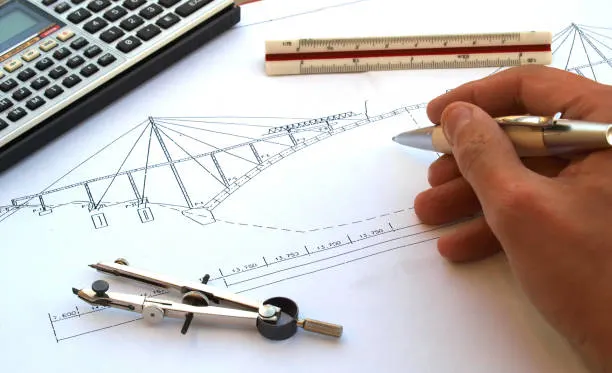
If you’ve ever watched a job lose a week because one trade was building off an old sheet while another trade was following the latest revision, you already understand the real risk behind construction drawings. On active construction sites, a single overlooked change can dramatically lead to delayed procurement, rework, inspection failures, and trade stacking that stretch the schedule.
That’s why the IFC Drawing (Issued for Construction) set matters. Issued for construction is more than a stamp in the title block; it’s a project control point. It tells the field, procurement, and subcontractors: this is the current contract-aligned direction to build from. And while every project team has its own workflow, the underlying concept is consistent: construction needs a controlled, buildable baseline that’s coordinated and trackable through revisions.
While IFC sets are multi-disciplinary, they often begin with a core set of architectural drawings that define the project’s scope.
Let’s explore more about IFC Drawings!
What Does IFC Stand For In Construction?
In the construction sector, IFC stands for Issued for Construction, which is a label used to designate drawings or specifications that are ready to be used for construction.
A professional practice reference from the Ontario Association of Architects describes Issued for Construction documents as bid drawings or specifications updated to incorporate changes, like addenda and negotiated changes. They also note that the drawings should be identical in content to the contract documents.
That same reference also notes that some groups use the term conformed or conformed documents for the idea of consolidating all official pre-award changes into the set the contractor will actually build from.
Another Meaning Of IFC In Construction
IFC can also mean Industry Foundation Classes, which is an open, vendor-neutral data standard, published under ISO 16739, and is used to exchange BIM information between software platforms.
So when someone says IFC, always confirm the context! (This guide focuses on IFC drawings in the Issued for Construction sense).
What Are IFC Drawings?
An IFC drawings package is the construction-ready drawing set released to build the work. In many workflows, it’s effectively the build from this baseline: coordinated across disciplines, aligned with the agreed scope, and incorporating issued changes, which often include addenda and negotiated revisions.
In other words, IFC is the moment when the drawings become the set that drives:
- Layout and dimensions in the field
- Long-lead procurement and fabrication decisions
- Inspection expectations, especially when AHJs want approved documents available
In fact, at the code-administration level, jurisdictions frequently require that approved construction drawings be available on site during inspections. One city bulletin quoting IBC/IRC language explains that when authorities issue the permit, construction documents are approved by stamp or writing, the building official retains one set, and another set is kept at the site and open to inspection.
The transition to an IFC set marks the shift from conceptual ideas to the specific difference between building plans and a blueprint used for field execution.
What Does Make An IFC Drawing Set Construction-Ready?
A high-quality IFC set is not just complete drawings. However, it is coordinated information packaged so that construction can execute with minimal interpretation risk. In the field, the most valuable IFC sets are the ones that reduce guessing and force the right conversations early, eliminating conflicts between subcontractors and the need for rework.
The Key Elements Of IFC
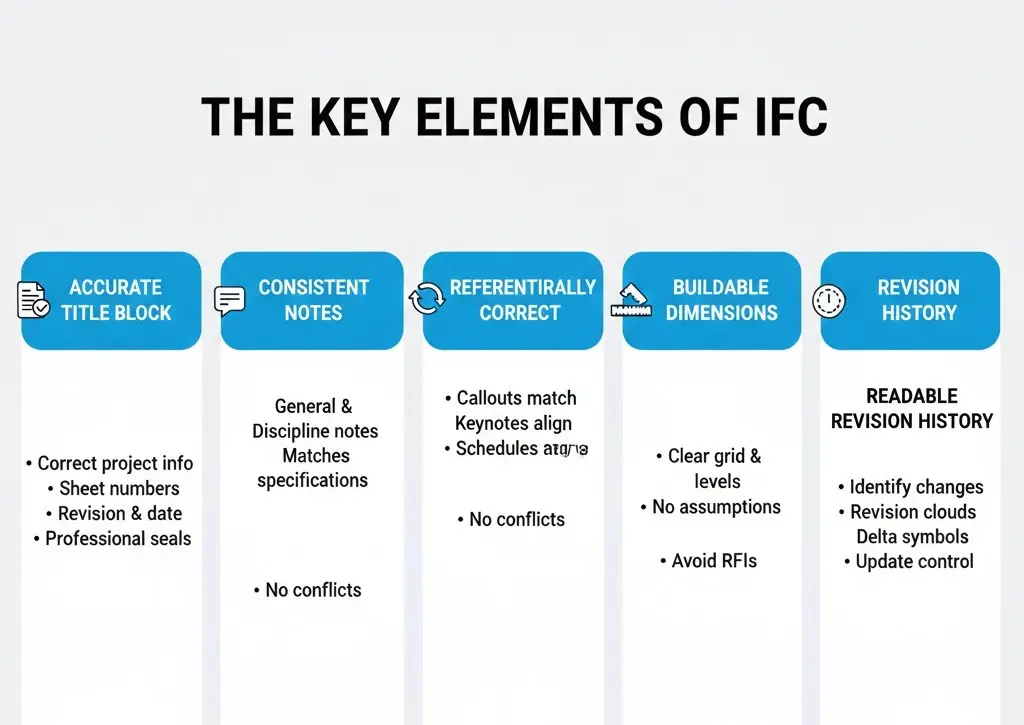
● Accurate Title Block & Administrative Data
Drawings must have the title block and administrative data that is accurate and precise. That means correct project identifiers, sheet numbers, current revision, issue date, as well as professional seals or signatures (where required).
The contractual definitions in AIA A201 describe Drawings and Specifications as components of the Contract Documents, so the administrative control of those documents matters.
● Consistent General & Discipline Notes
You must ensure that there is consistency between general notes, discipline notes, and project specifications. AIA guidance also emphasizes that drawings and specifications are intended to be complementary without creating a built-in hierarchy in A201-governed projects, which is why conflicts should trigger clarification.
● Internally Referentially Correct Plans, Sections, Elevations, & Details
This means that callouts point to the right detail; keynote legends match; typical details reflect the current design; and schedules align with the plan tags, like door schedule tags match door numbers, etc.
● Buildable Dimensions, Datums, & Control Points
This is where IFC quality becomes very real-world. If the structural grid, benchmark, column lines, top-of-steel elevations, and slab steps are unclear, the field will either:
- Stop and RFI
- Proceed based on assumptions
Neither is good.
● Readable Revision History
Whether you use revision clouds, delta symbols, revision blocks, or formal bulletins, the job needs a reliable way to identify what changed and when. Procore’s as-built summarizes common revision-marking conventions like revision clouds, delta symbols, and revision blocks as practical tools for identifying changes. Professionals use those same conventions throughout construction to control updates.
Types Of IFC Drawings In A Construction Project
On most commercial projects, the IFC construction set is multi-disciplinary. A typical package includes some combination of:
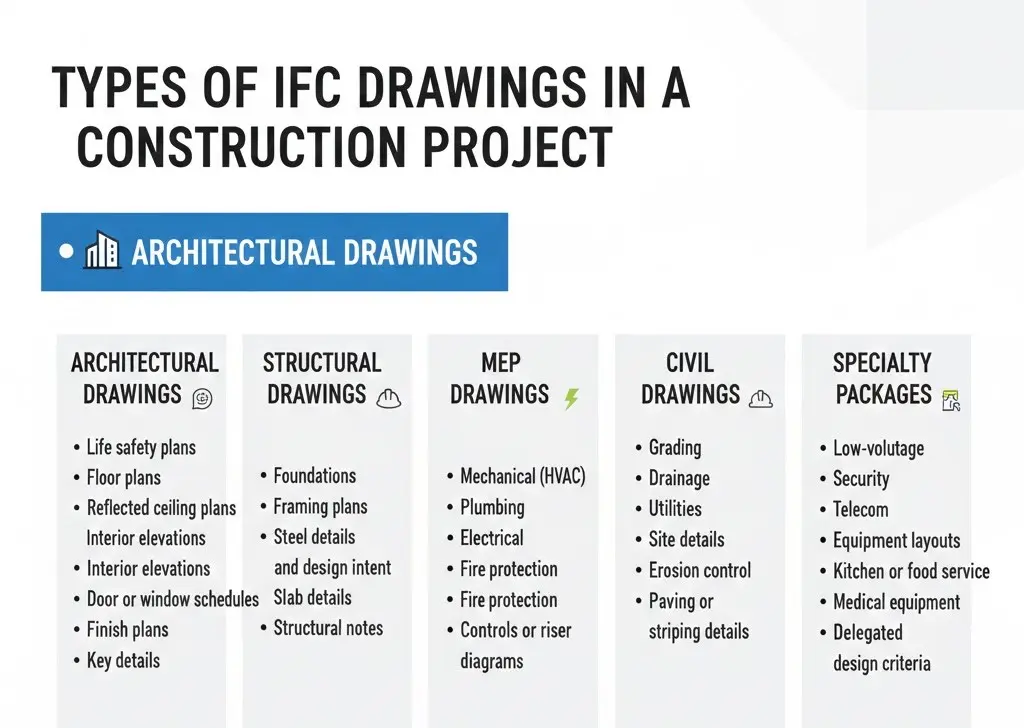
● Architectural Drawings
This includes:
- Life safety plans
- Floor plans
- Reflected ceiling plans
- Interior elevations
- Door or window schedules
- Finish plans
- key details
● Structural Drawings
This includes:
- Foundations
- Framing plans
- Steel details and design intent
- Slab details
- Structural notes
● MEP Drawings
This includes:
- Mechanical (HVAC)
- Plumbing
- Electrical
- Fire alarm
- Fire protection
- Controls or riser diagrams
● Civil Drawings
This includes:
- Grading
- Drainage
- Utilities
- Site details
- Erosion control
- Paving or striping details
● Specialty Packages
This includes:
- Low-voltage
- Security
- Telecom
- Equipment layouts
- Kitchen or food service
- Medical equipment
- Delegated design criteria where applicable.
A critical component of this set is the guide to foundation plan, which establishes the stability and footprint of the structure.
IFC Drawings Vs Other Construction Drawings
The industry throws around a lot of drawing types, and the names vary by market and contract form. But the risk doesn’t change. If your team doesn’t share the same definition, you will eventually build the wrong plan.
Below are comparisons:
● IFC Drawings Vs Tender Drawings
Tender drawings, often called bid drawings, bid set, or pricing set, are primarily intended to support competitive pricing and scope definition.
One useful way to anchor this is the distinction between Bidding Documents and Contract Documents found in EJCDC guidance, which says that
- Bidding documents include bidding requirements, proposed contract documents, and addenda.
- Contract documents are those items designated in the agreement that together comprise the contract.
So, tender or bid drawings sit closer to the proposed contract documents. IFC drawings sit closer to what governs construction now, especially after addenda and consolidation of negotiated changes.
Simply put, bid sets often have TBD selections, allowances, or incomplete coordination that get resolved later. However, IFC sets should not.
● IFC Vs Shop Drawings
This is the comparison that trips up newer APMs and even some seasoned supers when document control is loose.
In AIA A201, shop drawings and product data, samples, and similar submittals are explicitly not Contract Documents. Their purpose is to show how the contractor proposes to conform to the contract documents for portions of the work requiring submittals.
AIA A201 further states that the contractor must not perform work requiring approved submittals until the architect approves the submittal.
The CSI discussion on submittals says that because submittals are not contract documents, they generally cannot change contractual requirements on their own. If an approved submittal proposes something beyond the contract requirements and the project wants to enforce it, teams should handle it via an appropriate contract modification instrument, and not by making changes in submittals.
Simply put, an IFC drawings tell you what the design intent and contract require. However, a shop drawings tell you how a trade intends to fabricate/assemble/install to meet that requirement.
Maintaining a clear boundary between these documents is vital; you can explore the technical requirements of this process in our guide on the difference between design drawings and shop drawings.
● IFC Vs As-Built Drawings
As-builts are fundamentally different because they document what was actually installed, and not what was intended at issuance.
Cornell’s facilities guidance describes as-built drawings as drawings marked up in the field to reflect changes to design documents, often put together by the contractor for submission toward record documentation.
Procore similarly describes as-built drawings as a final set capturing notable changes made during construction and depicting the completed state, and they are often derived from marked-up redlines.
Simply put, the IFC set is your starting baseline, while the as-built set is your ending detail.
● IFC Vs Record Drawings
Team ofet confuses record drawings with as-builts. They’re related, but not identical. Cornell defines record drawings as a complete, clean set that reflects how the project was built by folding as-built revisions into the design documents. Designers compile them from the as-built information submitted by the contractor.
When Are IFC Drawings Issued?
There isn’t one universal date across all projects, but there are common points:
- IFC drawings are often requested immediately after the award, so the contractor has a consolidated build baseline. The OAA practice article notes that general contractors often request an Issued for Construction set right after contract award.
- In U.S. practice under common contract structures, the build baseline ties back to the Contract Documents structure. AIA A201 defines Contract Documents as the agreement, conditions, drawings, specifications, addenda issued before execution, other listed documents, and modifications issued after execution.
- Practically, many teams also align IFC issuance with key procurement needs. If the project has long-lead equipment, like switchgear, AHUs, curtain wall, and elevators, the contractor needs a reliable design baseline early enough to release submittals and fabrication without constant redesign churn.
Are IFC Drawings Revisable After Issuance?
Yes, almost always. Construction is a controlled change environment. Even after an IFC issue, projects evolve through clarifications, RFIs, addenda (pre-award), and modifications (post-award). AIA A201 explicitly recognizes Modifications issued after execution of the contract, including change orders, construction change directives, and minor changes in the work.
What matters is whether your team has a disciplined method to:
- Issue revisions in a traceable way
- Ensure every trade is building from the same current information
- Avoid silent changes that never make it into the official record
OAA discussion tells that producing an IFC set carries risk if it accidentally omits official changes or introduces unofficial changes. This is so because the set can be treated as governing construction even when it doesn’t perfectly match the contract record.
How to Use IFC Drawings On Site?
On a functioning site, the IFC set supports specific routines:
● Daily & Weekly Work Planning
Foremen plan installs based on the latest sheets. If your drywall labor is laying out walls from Rev 2 while the electrician is roughing in from Rev 3, you’ll win a rework package you never budgeted for.
● Layout & Verification
Total stations, control lines, embeds, and sleeve locations all trace back to drawing control. The more complex the structure ot MEP density, the more expensive a single layout error becomes.
● Inspections & AHJ Interactions
Many jurisdictions expect approved drawings to be available at the site and open to inspection. When inspectors show up, you don’t want a debate about which set is current.
● Submittals & Coordinated Installation
The IFC package drives what must be submitted, and submittals, which include shop drawings or product data, demonstrate how the contractor proposes to comply. AIA A201 frames this relationship clearly, including that submittals are not contract documents and are subject to review limitations.
A Field Control Checklist For IFC Construction Sets
Most document failures aren’t technical, but they’re procedural. The reliable teams enforce a short, non-negotiable control routine:
- Confirm the sheet’s revision or date matches the drawing register before layout or install.
- Verify RFIs, ASIs, bulletins, and change orders that affect the area are captured and distributed to affected trades.
- If two documents conflict, treat it as a clarification issue.
- Never let critical scope changes live only in a submittal; submittals are not contract documents and generally cannot change the contract requirements without a proper modification path.
IFC Drawings Common Challenges
● Design Coordination Gaps Across Trades
This shows up in MEP congestion, structural penetration conflicts, inconsistent ceiling heights vs duct routing, and equipment clearances that don’t survive installation tolerances.
● Late Scope Clarifications
Deferred submittals, value engineering decisions, or owner selections made after IFC can force a chain of revisions. Procore lists common reasons projects evolve, like material availability, constructability concerns, deferred submittals, and value engineering, which are the same pressures that can trigger post-IFC changes.
● Mismatched Document
Document mismatch between conformed changes and what the field holds. If the team doesn’t rigorously consolidate addenda or bulletins, labor teams end up with partial truths.
● Overreliance On Submittals To Solve Design Gaps
Submittals are essential, but AIA A201 makes clear they are not contract documents and do not relieve the contractor of responsibility for deviations unless handled properly.
Best Practices For Working With IFC Drawings
The strongest IFC workflows are compliment. They reduce surprises by making critical actions routine.
1. Start with a well-defined document of record mindset.
AIA A201 defines what contract documents are, and the team should mirror that clarity in how it labels and distributes IFC releases and revisions.
2. Treat every revision like it costs money.
This is essential because it does. Even if the design team can replot overnight, the field cost of a change depends on timing: after framing, after rough-in, after finishes, after commissioning. The later it hits, the more it multiplies.
3. Use disciplined revision marking and cross-references.
Revision clouds, deltas, revision blocks, and reference numbers aren’t busywork; they’re how you stop rebuilding the same mistake. Procore notes that these are common methods to show modifications and make them easy to identify.
4. Keep drawings accessible and current.
Field teams can’t comply with documents they can’t find. Jurisdictional expectations also reinforce that drawings should be available at the work site for inspection.
5. Don’t Create Secret Hierarchies.
Under AIA guidance, drawings and specifications are intended to be complementary without an automatic hierarchy. So if the job is treating one document as always controlling, that rule should be explicit in supplementary conditions.
Establishing this mindset early is easier when you understand the difference between building plans and a blueprint and how each serves as a legal record.
The Role Of Drafting & CAD Teams In IFC Documentation
This is where CAD drafting teams quietly determine whether IFC is a productivity tool or a rework generator.
A high-functioning drafting or CAD support team contributes by:
- Maintaining sheet discipline and revision integrity. The best CAD teams treat each issuance as a controlled release, preserving exactly what was issued and avoiding helpful silent corrections that never get formally transmitted. That risk, missing official changes or introducing unofficial ones, is called out directly in the OAA discussion of IFC set dangers.
- Driving coordination clarity through details, and not just lines. When CAD drafters support architects/ or engineers, they can tighten constructability by cleaning up callouts, aligning schedules, resolving overlapping notes, and making sure the sheet tells one clear story.
- Supporting submittal and as-built workflows. Shop drawings and submittals live downstream of IFC and are not contract documents, but they must align with IFC intent and are often the documents trades use to fabricate and install. AIA A201’s definitions and limitations around submittals shape how those workflows should operate.
- Helping closeout succeed. As-builts and record drawings rely on consistent change documentation. Cornell’s definitions highlight how as-built markups feed record drawings, and Procore describes how continuous updates can make final as-builts more accurate and efficient.
In short, drafting teams are often the air traffic control for IFC documentation. They make sure the right sheets, with the right revision, reach the right people at the right time.
Stop losing time to rework and uncoordinated revisions. Let our experts handle your IFC documentation with precision.
FAQs
How to know which drawing is IFC-ready?
On large commercial interiors, one of the most common failure points is above-ceiling coordination, like diffusers, lights, sprinklers, and return air paths competing for the same space. If the authorities issue the IFC set without adequate reflected ceiling coordination or without clear control elevations, you’ll experience ceiling grid delays, rework of hanger locations, and a chain of RFIs. All of these are preventable with tighter coordination in the IFC release.
Why are IFC drawings and shop drawings both required in a project?
They serve different purposes under standard construction administration logic. The IFC (Issued for Construction) drawings communicate the design intent and contractual requirements that the contractor must build. Shop drawings are contractor-furnished submittals used to show how the contractor proposes to conform to that intent for specific portions of the work. Under AIA A201, they are not contract documents.
Are IFC drawings prepared before shop drawings?
Yes. The shop drawing process is usually driven by the requirements in the contract documents (drawings/specs) and by the submittal schedule tied to construction sequencing. AIA A201 describes the contractor’s obligation to submit required shop drawings/product data/samples and emphasizes that work requiring approved submittals should not proceed until the submittal is approved.
Who should own the current se” on site, the GC or each subcontractor?
From a practical controls standpoint, the GC should own site-wide document control, but every subcontractor must also verify they’re working from the current revision for their scope. Jurisdictional expectations reinforce that approved drawings should be available at the site for inspection, which effectively forces a urrent set mindset.
What’s the fastest way to spot you’re holding a superseded IFC sheet?
Check the title block issue date and revision against the drawing log or register, then confirm you have any related bulletins/ASIs/RFI responses that affect the area. Also, look for revision clouds/deltas and revision blocks, common field-identification methods used to highlight what changed between versions.
Do IFC drawings include means and methods?
Generally, no. Under common U.S. contracting frameworks, the contractor is responsible for means and methods, while the design team communicates design intent and requirements through contract documents. Shop drawings and coordination drawings may reflect how the contractor proposes to implement the work, but those are submittals, and not contract documents.
Conclusion
IFC drawings aren’t just another deliverable; they’re the practical bridge between contract intent and field execution. When the team treats the IFC set as a controlled baseline, you reduce RFIs, rework, schedule drift, and the hidden cost of trade stacking. When IFC control breaks down, the field doesn’t stop building; it just starts guessing, and the project pays for it later.
If you need precise, coordinated IFC Drawing sets, redlines, or conversion from BIM to 2D, CAD Drafters supports architects, engineers, and contractors across the U.S. with precision CAD drafting, revision control, and fast turnarounds. This way, the team keeps field teams building from the right sheet. Send your plans today for a same‑day scoped quote!