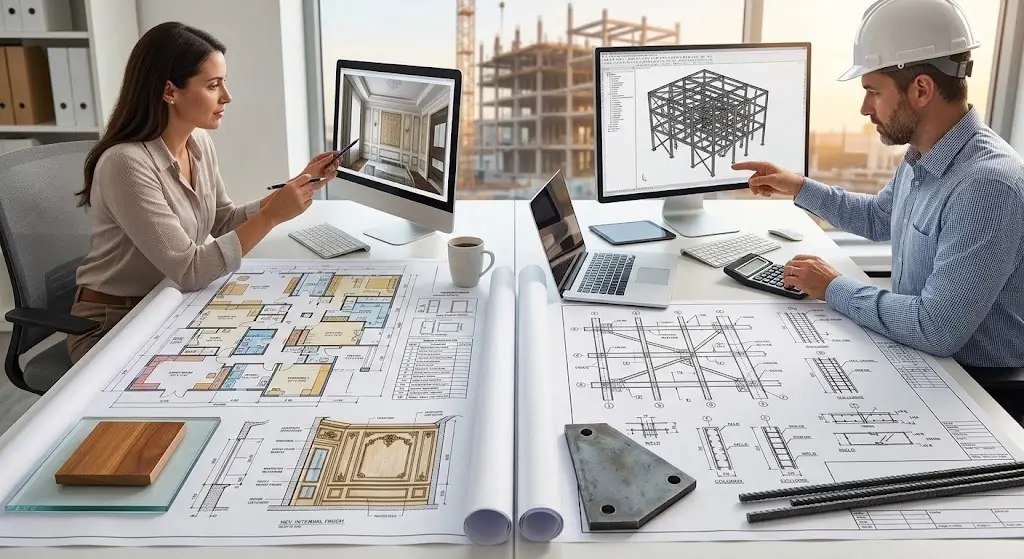
Imagine planning a surprise party without a guest list or a map; you will still have fun, but chances are you’ll forget something major. In building design, a structural design drawing is that crucial map. It ties together the architect’s vision and the engineer’s checks.
Consider structural design like a recipe. If you skip or mismeasure an ingredient, the whole cake can flop. A solid plan includes the blueprints, loads, and materials, and these things make sure the final structure bakes safely.
In this blog, we’ll unpack how we go from initial analysis to the set of construction drawings that bring a construction project to life.
What Is Structural Design?
Structural design is basically planning a building’s skeleton so that it won’t collapse. Engineers calculate all the loads, including dead weight, people, wind, seismic, etc., and pick the right materials and sizes, so the structure can handle worst-case forces.
In other words, it’s turning that initial sketch or architectural idea into something that actually stands up under gravity and weather. By applying math and physics, structural design ensures beams, columns, and foundations are strong and balanced. It’s the behind-the-scenes work that answers “Will this building live long and stay safe?”
The Importance of Structural Design in Construction
Structural design is non-negotiable for a reason. It ensures safety and durability from Day 1. In fact, a clear design tells you exactly what foundation, beams, and materials you need, so that all safety codes are met.
Without it, you’d basically be guessing what holds a building up, which is a recipe for disaster. Precise & accurate structural plans also optimize materials, which means saving money by using no more steel or concrete than needed.
In short, reliable design makes buildings more cost-efficient and long-lasting. It literally prevents failures, like experienced engineers ensure structures can handle the forces and don’t ever collapse unexpectedly. Simply put, structural design turns a sketch into a real, safe building.
What Are the Basic Structural Design Requirements?
Every structure must meet several key requirements. Explore them below:
● Stability
The building mustn’t slide, tip over, or buckle under loads, like earthquakes, wind or the building’s own weight. It’s about balance and support that keep it from toppling or shifting.
● Strength
All members, including beams, columns, and walls, must safely resist the expected stresses. In other words, the frame should never crumble under loads. It is like answering the question, “Is that column strong enough for the floor above?
● Rigidity/Serviceability
Even if it stands up, the building must not drop, shake, vibrate or crack beyond limits under normal use. This keeps doors and windows working, eliminates the chances of cracks in floors, and ensures comfort.
● Durability
Materials and details in a building must last. Steel should resist corrosion, concrete shouldn’t crack from freeze-thaw, and connections must endure the building’s life. In a durable design, maintenance is minimal, and the structure outlives its original purpose.
● Economy & Efficiency
We must hit the first 3 requirements within budget. An experienced designer knows the costs and selects materials and sizes to avoid waste. Using the right material and optimizing shapes, you can keep costs down while still meeting strength and stability targets.
● Compliance & Safety
Last, every design must meet building codes and safety standards. This means fire ratings, seismic rules, and other regulations are baked in. In the end, a code-compliant design means the building is legal and, most importantly, safe for people.
7 Steps of Structural Drafting
Structural drafting follows a clear, iterative process. Each step builds on the last and usually loops back if something needs refinement. Here’s the typical workflow:
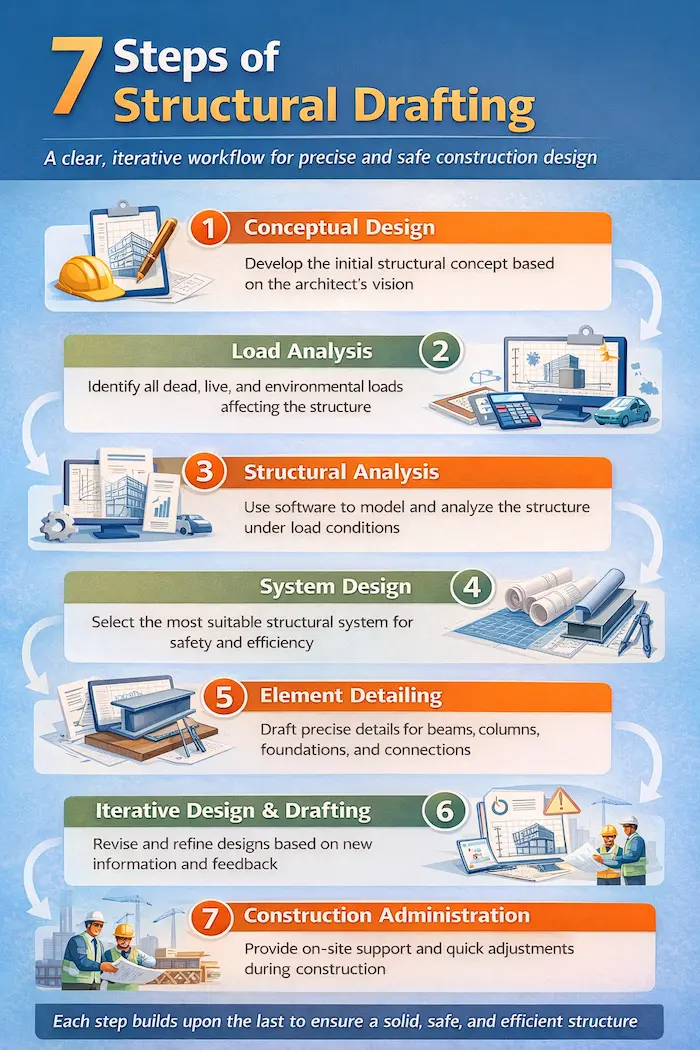
1. Conceptual Design
Professionals start with the architect’s vision and sketches. What does the building look like, and how will it be used? At this stage, they consider the basic structural system.
Early sketches include preliminary sizes for columns and beams, oriented according to the building’s layout. This big picture phase often involves brainstorming with the whole team. The goal is to align structural feasibility with the concept of the project.
2. Load Analysis
Next, the teams figure out the loads, answering What forces must the structure carry. Professionals list all dead loads (the weight of the structure itself and permanent fixtures), live loads (furniture, people, vehicles), and environmental loads (wind, earthquake, snow, etc.).
For example, a library floor might need to support heavy book stacks, while a roof in a snowy climate needs higher snow loads. Teams often use building codes to set these values. Once the loads are defined, you have the numbers you feed into the analysis.
3. Structural Analysis
Now comes the math with some software help. Using tools like finite element analysis (FEA) or specialized structural software, teams model the frame or structure under those loads. The program calculates stresses, deflections, and reaction forces.
Teams ensure:
- Do any beams bend too much?
- Are certain columns overstressed?
If something fails the criteria, they modify the model. This iterative remodeling continues until the structure checks out. Modern engineers often run several analyses, including a quick linear one, and possibly a dynamic analysis for things like earthquake response.
4. System Design
With loads and analyses in hand, drafters pick or refine the structural system. This is where experience guides choices on concrete vs steel vs wood, moment frames vs braces, flat slabs vs beams and joists, etc. The goal is to pick a system that’s safe, constructible, and fits the architectural vision.
This step often involves collaboration with architects and contractors to make sure the structure fits the overall project plan.
5. Element Detailing
Once the system is set, each piece gets detailed drawings. Drafters specify exact dimensions and materials for every beam, column, foundation, and connection. For example, a beam drawing will show its length, cross-section, reinforcement layout (if concrete), and how it connects at the ends.
Detailing is very precise. Therefore, certified teams note steel grades, concrete strengths, and embed plate locations. This is where drafting becomes the actual construction blueprint. Furthermore, precise detailing ensures that when labor builds, each element is exactly what teams calculated.
6. Iterative Design & Drafting
Structural design is rarely linear. Often teams revisit earlier steps based on new information. Maybe the owner changes the layout, or a clash is found with MEP systems. In those cases, they loop back to update loads or geometry, re-analyze, and re-detail as needed.
Each revision is carefully documented. Throughout, teams keep checking their work. Modern teams use BIM platforms so that any change updates all associated drawings, which helps catch conflicts early.
7. Construction Administration
Once construction starts, the team’s role shifts to support. They review submittals, like shop drawings for steel, answer contractor questions, and ensure the structure is built per the design.
If on-site issues arise, such as an obstacle in the foundation, they issue a quick revision or workaround. This way, professionals keep the design alive during construction. The result is a set of signed-off construction drawings and a safe, complete structure on site.
Technologies Used in Structural Designing
Modern structural engineering relies heavily on digital tools. These tech platforms boost accuracy and speed at every stage of drafting:
● Building Information Modeling (BIM)
BIM is a shared digital model of the building. Imagine a 3D Lego model where every brick knows its properties. BIM lets architects, structural engineers, MEP designers, and contractors work on the same model simultaneously.
Using it, you can make edits in one place and automatically update everything. This real-time collaboration catches clashes, like a beam hitting a duct, before they happen in the field.
As one expert notes, BIM connects teams, workflows and data across the entire project” for better outcomes. Also, BIM tools, like Revit, provide greater visibility and better decision-making, saving time and cost. If BIM is new to you, see our What is BIM? guide.
● Computer-Aided Design (CAD) & Drafting
Traditional drafting has moved to CAD software. Today, engineers use AutoCAD, Tekla, or Revit to draw floor plans, sections, and details. CAD ensures precision, which means lines snap to scale, changes are tracked, and copies can be generated quickly.
These tools handle layers and standards, so every drawing element, including beams, slabs, and annotations, follows a consistent style. CAD software also automates tasks, like calculating quantities. In short, this software turns hand sketches into exact blueprints with far less effort.
● Finite Element Analysis (FEA)
For complex parts or loads, FEA tools come into play. This involves breaking a component into elements and calculating stresses. Structural engineers often use FEA to simulate how a tricky connection or an odd-shaped roof will behave.
Rather than relying on hand estimate assumptions, FEA gives a detailed picture of stress distribution. It’s especially handy for checking things, like a long-span roof, a high-rise shear wall, or a bridge deck.
● Parametric & Generative Design
These are the hot new tools. Parametric design means defining rules and letting the model adjust. For example, make every column this distance apart, and adjust their height to fit the floor. Using this, you will experience: change one parameter and the model updates automatically.
Generative design takes it further, meaning you input goals and constraints, like loads, material type, and cost targets, and an AI-like engine spits out many design options. It might suggest a lattice structure or a tapered column you wouldn’t have thought of. This AI-driven process is part of the reason AI in Construction Has Landed; it’s revolutionizing how fast you can explore safe designs.
● Sustainable Design Practices
Structural engineers also apply green building ideas. This includes choosing recycled or low-carbon materials, like fly-ash concrete or reclaimed steel, and designing for life-cycle efficiency.
Teams run Life Cycle Assessments (LCAs) to measure a structure’s overall environmental impact. For example, drafters might select concrete mixes that use industrial by-products or add solar panel arrays to roofs during the design.
What to Ensure in Structural Drafting: Accuracy and Precision
When creating the final drawings, accuracy is everything. Even small errors in dimensions or specifications can lead to major problems. Therefore, teams double-check every number because:
● Safety & Structural Integrity
A one-millimeter mistake on paper can lead to a big headache on site. In other words, wrong beam sizes or mislocated columns can weaken a structure. Precise drawings ensure the building will perform exactly as analyzed.
● Cost Control & Efficiency
Accuracy is a money-saver in structural drafting. One study found that inaccurate data and miscommunication drive up to 4–11% (and in some cases even ~20%) of a project’s cost in rework. In other words, poor drawings can put a serious dent in the budget. By nailing the details early, you can avoid waste and extra material orders later.
● Reduced Rework & Delays
Clarity up front means fewer change orders in the future. Clear, coordinated drawings cut down on Requests for Information (RFIs) and on-site clashes. Each avoided clash, or RFI, means a task saves days or even weeks. Simply put, accurate plans keep the construction project’s schedule tight.
● Improved Collaboration
Precise drawings are like speaking the same language. Architects, engineers, contractors, and fabricators can all read and trust what they see. When everyone references the same specifics, teamwork flows more smoothly, and there’s less guesswork.
Pro Tip: If you are not confident in efficiently chasing all these points when drafting structural designs, you must benefit from structural drafting services offered by the experts in the industry.
How to Choose the Right CAD Specialist
Choosing a CAD partner isn’t just about finding a drafter; it’s finding a precise, professional designer who takes ownership of the structural plans. With the right person, you gain peace of mind that the drawings will be as sound as the design. Check the following when hiring someone.
● Relevant Experience & Expertise
Ensure “Have they done work on similar buildings?”, because a drafter familiar with your project type will anticipate common issues. Check their portfolio and prefer seasoned professionals who often highlight past structural drafting projects. If they’ve tackled buildings like yours, they’ll know which standards and tricks apply for the best outcomes.
● Software Proficiency
Ensure they master the tools you need. That might be AutoCAD for 2D drafting or Revit/ Tekla for 3D models and BIM. If your project uses BIM, pick someone with proven BIM experience. Doing so is essential because an expert who can smoothly handle the right platform will work much faster and avoid errors.
● Quality Control & Accuracy
Ask about their QA process. Do they do cross-checks and peer reviews of the drawings? Reliable firms have standards, like layer conventions, template files, and checklists, so that every drawing is consistent. You can also request a sample output or references to see how precise and clear their past work is.
● Communication & Collaboration
A CAD specialist should work as part of your team. Ensure “Do they respond quickly, explain issues clearly, and use collaborative tools, like shared cloud models?” Good communication means they’ll catch your questions about the design before it’s too late.
Remember, the more they ask about your goals and constraints up front, the fewer surprises later.
● Project Timeliness & Reliability
Building schedules are tight, so deadlines are crucial. Check if the firm has a reputation for on-time delivery. You can ask for previous clients or read reviews. Also consider their capacity, which means do they have enough staff to handle your project on time. It is essential because reliability often goes hand-in-hand with experience.
Ready to partner with a CAD specialist who delivers precision, reliability, and expertise for your structural projects?
Conclusion
In the end, structural design is the bridge between a creative concept and a safe, built reality. It starts with conceptual sketches, runs through load checks and analysis, incorporates BIM and CAD technologies, and ends with detailed construction drawings. The overarching rule is accuracy, which means every dimension, material choice, and calculation must be precise. With each step, teams aim to make buildings stronger, smarter, and more economical.
When you need help turning plans into production-ready drawings, our team at CAD Drafters has you covered. Our structural drafting & design services handle everything from concept modeling to final drawings, using the latest BIM and CAD tools. We specialize in structural drafting services and BIM Modeling to keep your project on track.
Trust CAD Drafters to make your next build safe, efficient and exactly to the specifics!
FAQs
What are the main steps in the structural design of a building?
The typical steps are:
- Conceptual design (overall layout)
- Load analysis (dead, live, wind, seismic, etc.)
- Structural analysis (using software or calculations)
- System selection (choosing frame types)
- Detailed design (sizes of beams/columns/foundations)
- Iterative review
- Drafting construction drawings
- Construction support and administration.
How to read structural drawings for new construction?
Start by checking title blocks and legends for scale and symbols. Look at each drawing set: plans show column and beam locations, sections and details show member sizes and reinforcements. Note the notes and schedules, like beam or footing schedules. Follow load paths visually from roof to foundation. In short, read it top-down: general plans first, then sections, then fine details.
Why is structural design important in modern construction?
Structural design is important because it ensures buildings are safe, durable and code-compliant. It balances creativity with physics, which means you get the look you want and a frame that won’t crumble.
How does structural design improve construction efficiency?
By optimizing material use and resolving conflicts early. Clear structural plans reduce wasted steel/concrete and catch clashes, like pipes through a column, on the computer instead of on-site.
How to deal with existing conditions in structural designing?
First, thoroughly survey what’s there. Document any issues or damage in the existing structure. Then model those conditions in your design tool or drawings. Often, you’ll need to retrofit elements or allowances in the design. Essentially, start by designing with reality, including existing walls, foundations, etc. If something surprises you on site, adjust the design and details as needed and record the change.
What is load analysis in structural designing?
Load analysis is the process of identifying all forces the structure must support. This includes dead loads (the building materials’ own weight), live loads (people, furniture), and environmental loads (wind, earthquake, snow, etc.). Engineers compute these loads based on codes and calculations. The analysis ensures every beam, column, and footing is sized to carry the predicted loads safely.
What is the difference between conceptual structural designs in construction?
Conceptual design is about the overall look and layout of a building, meaning sketches, massing, and basic materials. On the other hand, structural design is the engineering follow-up as it takes the concept and figures out how it stands up.
In other words, conceptual design is the creative vision, and structural design is the detailed, technical plan that makes that vision physically possible.