Millwork and woodwork are the two terms that most people confuse. If you are one of them, you are on the right page to know the differences between the two. To start, you must know that one leans on repeatable precision, while the other leans on human craft. Let’s dive into the details!
What is Millwork?
Millwork covers wood products made in a mill or factory for a building’s finish. For example: doors, windows, trim, stairs, and baseboards; these are the elements that laborers install on site. Many shops produce them in standard profiles and sizes, yet they can still customize details when designers push.
Elements of Millwork
- Doors and door casings
- Window casings and trim
- Crown molding
- Baseboards
- Chair rail
- Wainscoting
- Wall paneling
- Stair parts and railings
- Cabinets and vanities
- Built-in shelving and storage
These names cover most scoped millwork sets on residential and commercial projects.
Benefits of Millwork
Millwork helps teams control project scope because it supports repeatable, precision-made components. As a result:
- Builders can plan installation sequences and reduce on-site improvising.
- Also, designers can keep a consistent profile language from room to room.
- Meanwhile, owners get elements that integrate with the building instead of floating inside it.
- When you draft it right, you also cut coordination issues between trades and reviewers.
- As a result, teams draw clear lines, and punch lists stay shorter at turnover.
What is Woodwork?
Woodwork describes the broad craft of shaping, assembling, and finishing wood into something useful or beautiful. That can mean a dining table, a carved detail, custom cabinetry, or a one-off sculpture.
Woodworkers often build pieces by hand or with small-shop machinery, and they tune details as the design evolves. Furthermore, it can still land inside buildings, of course, but it stays movable often. However, it doesn’t always need to lock into architectural geometry the way millwork does. So, the drawings can focus more on proportions, joinery intent, and finish character.
Elements of Woodwork
- Custom furniture
- Tables and chairs
- Carved decorative pieces
- Turned wood bowls
- Outdoor benches
- Wood sculptures
- Hand-built shelving
- Decorative mantels
- Artisan cabinets
These names cover common woodwork pieces that shops build in smaller, custom batches.
Benefits of Woodwork
Woodwork shines when you want personality that doesn’t come from a catalog. It supports one-off solutions, so designers can chase shapes that feel made for this room. Also, many woodworkers select higher-grade or specialty lumber for visual impact.
Because they tune details by hand, they can deliver sharp craftsmanship where it matters most. For statement pieces, that extra care can pay off over time. Even better, it lets you match a client’s taste without forcing standard profiles.
Major Differences Between Millwork & Woodwork
This table helps you align project scope, cost, and drawing sets fast. When estimators ask what millwork is, this table answers in seconds. Hence, you can use it during takeoffs, submissions, and schedule planning when you have a short time to make a decision.
| Factor | Millwork | Woodwork |
| Purpose | Integrated finish parts | One-off crafted pieces |
| Manufacturing Method | Shop/mill, standard or semi-custom | Hand or small shop, one-off |
| Customization Options | Controlled options; custom dims as needed | High freedom; evolves with the maker |
| Scope of Use | Finish stage, built-ins | Furniture, decor, accents |
| Cost | Lower at scale; custom raises cost | Higher labor for one-offs |
| Materials | Solid + engineered products | Often, a solid lumber variety |
| Installation Time | Faster when pre-made | Slower when fit on site |
| Architectural Drawings | Heavy drawing dependence | Varies; built-ins need detail |
| Examples | Trim, casings, built-ins | Tables, carvings, decor |
How does Millwork Differ from Woodwork in Architectural Drawings?
When you draw millwork, you draw the building’s finish structure. On the other hand, when you draw woodwork, you often draw a product. That difference changes what you show, what you tag, and what you verify. Let’s break it down!
● Design Focus
Millwork drawings must protect fit, alignment, and interface with adjacent construction. Therefore, designers and drafters prioritize openings, reveals, and precise transitions at walls. Woodwork drawings can prioritize the object itself, like furniture proportions and balance. In other words, millwork serves the building first, while woodwork serves the piece first.
● Level of Details
Millwork needs technical depth because shops fabricate from the sheets. Therefore, you must include exact dimensions, profiles, material callouts, and installation instructions. A study also notes that shop drawings are a primary visual communication tool for coordination. Woodwork can stay more visual for artistic pieces, yet built-ins still need shop precision.
● Customization
Millwork can follow predefined profiles, yet projects still need custom sizing. That mix forces you to control the variation sheet by sheet for the shop. However, woodwork usually invites iteration, so you might revise details as makers refine joinery. Therefore, woodwork drawings often change later in the design cycle.
● Tools Used
Millwork drafting relies heavily on CAD accuracy. Therefore, teams often draft with tools, like AutoCAD, for measurable outputs. On the other hand, woodwork drafting can mix CAD with renderings and sketches for client buy-in. Still, once woodwork becomes built-in, CAD detail becomes non-negotiable fast.
Difference Between Millwork & Woodwork Regarding Drafting
Drafting takes place between design intent and shop reality, and that placement feels solo sometimes. However, it also gives you leverage when meetings start spinning in circles. When you draft the right project scope, teams stop putting out conflicts.
Let’s talk about the drafting differences that impact cost and maintenance!
● Design & Style Options
Millwork often uses manufactured components and repeatable profiles, so style options stay curated. That helps designers maintain cohesion across trim, built-ins, and stair parts. However, woodwork opens wider style freedom because makers can slice and shape solids. Hence, drafting for woodwork often includes more visual cues to protect the artistic direction.
● Quality & Durability
Millwork can deliver consistent results because mills control processes and outputs. However, woodworking makers often run for uniqueness and select higher-grade materials. This is the reason that durability depends less on the label and more on execution and detailing. For drafters, that means documenting grade expectations and performance intent early.
● Maintenance Considerations
Millwork ships are prefinished or use durable assemblies, so owners see simpler upkeep. Still, wood moves with humidity, and it reacts to heat and handling. This makes protecting architectural woodwork from humidity effects essential. In addition, you must look for acclimation and controlled conditions during storage and install.
Advantages of Millwork Over Woodwork
The difference isn’t good versus bad; however, it’s about repeatable outcomes. That difference matters most when the finish schedule gets tight. So, if you manage multiple rooms, millwork can make life easier. Let’s explore some of its benefits over woodwork!
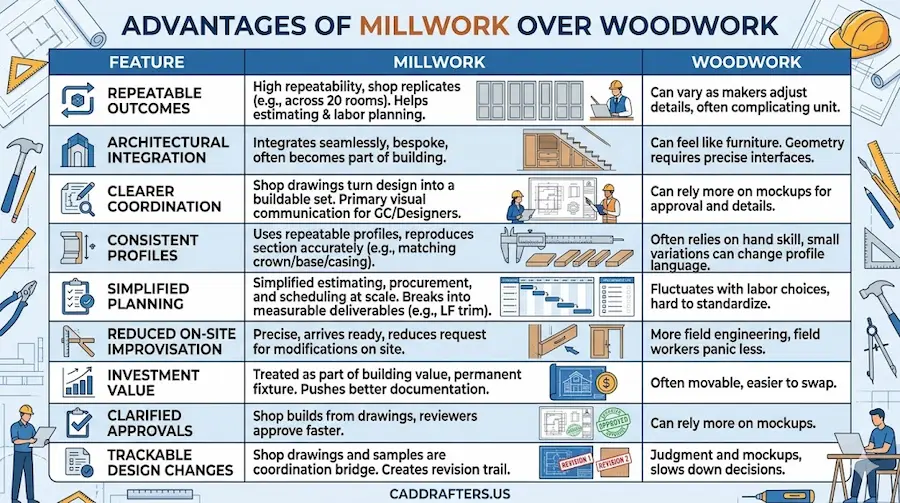
● Millwork delivers a repeatable fit across many identical locations.
It supports precise, repeatable components that must fit inside defined spaces. Thus, when you repeat a panel wall across 20 hotel rooms, the shop replicates it. That repeatability helps estimators estimate by typicals and helps PMs plan labor. Meanwhile, woodwork can vary as makers adjust details, which often complicates unit takeoffs.
● Millwork integrates with architecture instead of fighting it.
Millwork often becomes part of the building. As per a study, a bespoke millwork integrates seamlessly when teams measure openings. That matters for stairs and under-stair built-ins where geometry gets weird. If you miss those interfaces, you’ll patch drywall forever, and nobody wins.
● Millwork supports clearer coordination through shop drawings.
Shop drawings turn design intent into a buildable set, with coordination baked in. Simply put, it is a primary visual communication source between the manufacturer, GC, and designers. Using it, drafters can show backing locations, clearances, and conflicts early. This way, the team answers questions on paper instead of on systems. That’s how you earn better projects and better builds, even on deadlines.
● Millwork produces more consistent profiles, reveals, and finishes language.
It usually uses repeatable profiles so that you can control a building’s plans. That helps designers keep crown, base, and casing profiles consistent across floors. Also, mills reproduce a section accurately once you lock the profile. However, woodwork can still match profiles, but it often relies on hand skills. This means that small variations can change every profile that relies on hand skill.
● Millwork can simplify estimating, procurement, and scheduling at scale.
When parts come from a controlled shop environment, teams plan around lead times. Also, millwork sets break into measurable deliverables, like linear feet of trim. That structure makes procurement streamlined, especially when you group items by finish. On the other side, woodwork is harder to standardize, so the cost can fluctuate with labor choices.
● Millwork reduces on-site improvisation and field engineering.
Millwork is a functional building element that often arrives ready to install. In other words, millwork is a precise, repeatable component that fits spaces well. That approach reduces the request to modify to fix functionally issues on the site. It doesn’t eliminate problems, but it reduces them before the field workers panic.
● Millwork gives owners a more permanent, building-level investment.
As per a study, millwork pieces often function as permanent fixtures once installed. Therefore, owners treat them like part of the building’s value, and not furniture. That permanence also pushes better documentation, because replacements match profiles. In contrast, woodwork can still be permanent, yet many woodwork items remain movable and easier to swap.
● Millwork clarifies approvals, so the shop doesn’t guess your intent.
Millwork lives and dies by approvals, because the shop builds from the set. So, when drawings show profiles, sections, and hardware clearly, reviewers approve faster. For woodwork, it still needs approvals sometimes, but it can rely more on mockups.
● Millwork keeps design changes trackable instead of chaotic.
Finish sets change, even on tight jobs, and that’s normal. However, millwork drafting creates a precise revision trail your whole team can track. Therefore, professionals use shop drawings and samples as the coordination bridge for execution. Consequently, when designers modify profiles, estimators, PMs, and shops all see it. Woodwork can still evolve through judgment and mockups, which slows down decisions sometimes.
The Right Time for Choosing Millwork & Woodwork
Most teams don’t choose either-or, and they choose a sensible mix. Still, you can pick the right default early, which saves weeks later.
Here’s how you should frame it for estimators, architects, and project managers.
● Choose millwork when you need a predictable fit and repetition.
If you build kitchens, closets, hotels, or tenant improvements, repetition drives value. Millwork supports precise components that integrate into the building’s geometry reliably. So, you can draft an approved template and reuse it with controlled variation. That keeps submission tighter and speeds field installation planning for every floor.
● Go for woodwork when the piece must feel singular and expressive.
When the project needs a hero element, woodwork can carry that weight. This can include sculptural reception desks, carved wall art, or one-off furniture with personality. Woodworking stays broad, and it welcomes craft decisions during making. This way, you can protect intent with visuals and key dimensions, plus collaborate on details with confidence.
● Choose a hybrid when you want both schedule control and warmth.
A hybrid approach works well in real projects, because budgets stay real. Use millwork for repeatable shell pieces, like trim, cabinets, and built-ins. Similarly, use woodwork for a focal detail, like a carved feature or table. A study notes that many professionals do both, depending on the project scope. That mix keeps the timeline on point while still delivering quality.
● Make the call early, then draft to the right level.
As you know, shop drawings are the key coordination tool because they turn intent into reality. Therefore, you must pick your project scope early and, later, decide what the shop must know. If you delay that decision, you’ll redraw in a panic later. Also, if you over-detail early, you’ll waste hours on things that change. Simply put, balance matters because you need detail without locking premature decisions.
Make the right call early—get precise millwork and woodwork shop drawings that eliminate rework and delays.
FAQs
Is casework the same thing as millwork?
Casework refers to box construction, like cabinets, bookcases, and storage units. It can be partially or fully prefabricated to standard sizes. On the other side, millwork covers a wider range of mill-made products, like doors, trims, and panels. You can say that casework is a type of millwork in many projects.
When do you actually need shop drawings for woodwork?
You need shop drawings when a woodwork item must integrate with the building. Built-ins, under-stair storage, and custom cabinetry require exact diagrams to install well.
What should millwork shop drawings show to avoid RFIs?
Start with dimensions, profiles, materials, and hardware locations that match the project scope. Also, show interfaces, like wall returns, reveals, and adjacent finish transitions. In addition, add notes that clarify responsibility and hold-to dimensions when needed.
What belongs in a millwork submission set besides the drawings?
Drawings do the heavy lifting, but reviewers often need more context. You should include material data, samples, and product data, plus list sample types that matter for review, like machined profiles and veneer flitches. Furthermore, adds finishes, core materials, sheet products, and hardware to the list.
Why do millwork packages sometimes take longer to install?
Millwork often starts with measuring the space carefully. After that, the team translates those dimensions into a technical drawing for fabrication. Next, the shop builds bespoke parts and installs them professionally on site. That chain adds time, even when the final result looks effortless.
How to keep millwork details consistent across a whole building?
Lock a profile library and reference it everywhere consistently. That includes base, crown, casing, panel reveals, and edge banding conditions.
How to decide between millwork and woodwork for a single room?
First, ask if the element will stay permanent in the building. Next, ask if the element will repeat across rooms or floors. If it integrates with architecture and repeats, millwork usually wins. But if it stands alone and carries expression, woodwork often makes more sense.
Where do most projects go wrong with millwork documentation?
If you skip coordination details, like openings, backing, and finish transitions, the project goes wrong. You can waste a lot of time and money this way. The fix is simple: document the interfaces early and review them together.
Do shop drawings replace architectural drawings?
No, they serve different jobs, even when they share the same geometry. Architectural drawings communicate design intent and overall coordination across the whole project, while shop drawings communicate how the manufacturer will build and install the product.
Conclusion
Millwork and woodwork both create beautiful outcomes, but they solve different problems. Millwork fits into construction with repeatable, precision-made components that support schedules. On the other side, woodwork stays broader, and it shines when you want craft, variation, and personality.
Most importantly, the right drawings protect the right scope every time. If you still ask what millwork is, look at how drawings drive outcomes. That’s how you prevent field fixes that waste money and energy.
Need millwork & casework shop drawing services, and want fewer redlines during review and fabrication on fast timelines. CAD Drafters turn design intent into shop-ready CAD sheets with dimensions, profiles, hardware, and install notes. So, estimators price faster, PMs coordinate sooner, and builders install perfectly with fewer surprises on site.